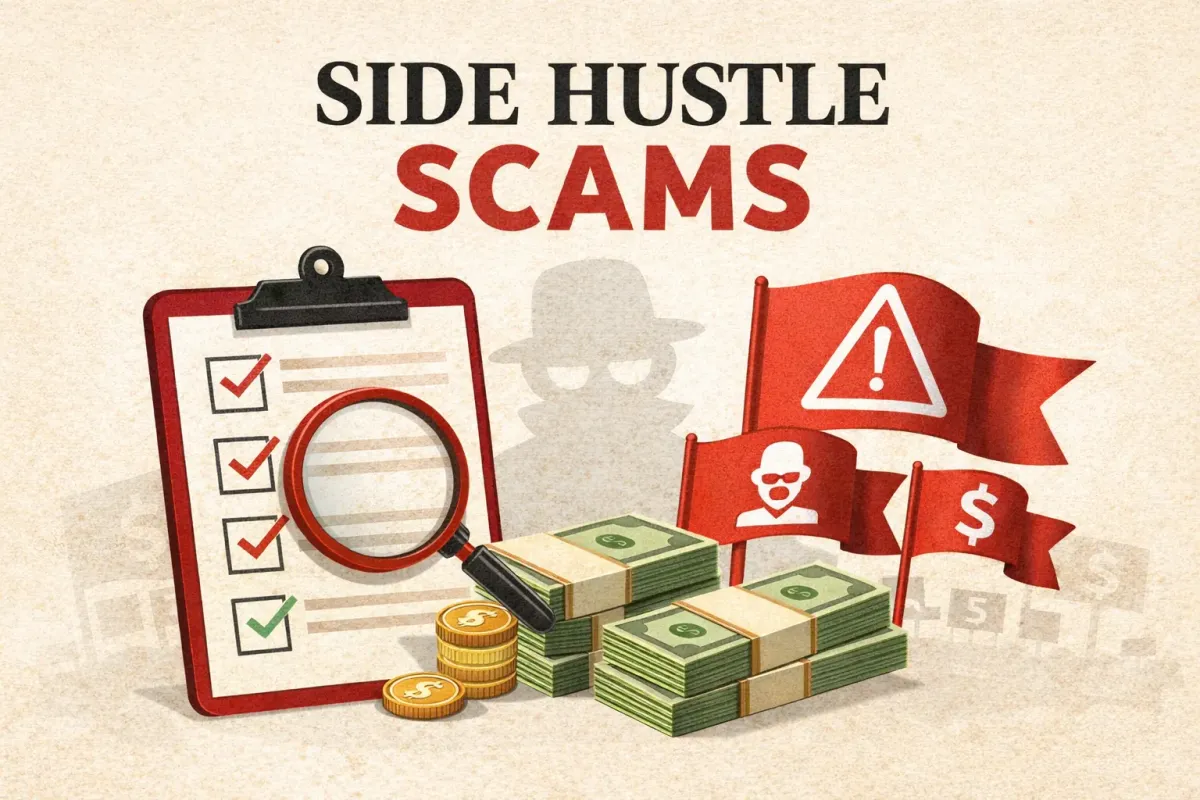
Side Hustle Scams: Red Flags to Avoid Fake “Opportunities"
Learn the most common side hustle scams and the red flags that expose them—fees, fake jobs, shady “gurus,” and identity traps. Includes a quick checklist to verify any opportunity before you waste money or time.
Side hustles can be a smart way to build extra income, learn new skills, and create more financial breathing room. But as interest in side income grows, so does the number of scams targeting beginners.
Scammers know exactly what people want to hear: easy money, fast results, no experience required. They use polished websites, convincing “testimonials,” and friendly messages to create trust—then they apply pressure to get money, personal information, or free labor.
This guide breaks down the most common side hustle scams, the red flags that give them away, and a scam-proof checklist beginners can use before committing time or money. It also covers what to do if someone has already been scammed and suggests safer alternatives for building side income without stepping into a trap.
What Counts as a Side Hustle Scam?
A side hustle scam is any “opportunity” that uses deception to take something valuable from a person—usually money, personal information, or unpaid work—without delivering the promised outcome.
Not every bad side hustle is a scam. Some are simply low-quality, overhyped, or not beginner-friendly. But scams share one trait: they are designed to benefit the scammer, not the beginner.
The 3 broad categories of side hustle scams
1) Money extraction scams
These scams exist to collect payments. The “hustle” is just the bait.
Common examples:
- “Pay a small fee to start”
- “Buy the starter kit to unlock clients”
- “Pay for training, certification, or onboarding”
- “Pay a deposit that is ‘refundable’ later”
The scam may look like a job offer, a franchise deal, a course, or a business partnership. The goal is the same: get paid upfront.
2) Data and identity scams
These scams aim to steal personal information or access to financial accounts.
Common examples:
- Fake job application forms that collect ID documents
- “Verification” steps that request bank logins or wallet details
- Links to fake portals that capture passwords
- “Payroll setup” requests before any real hiring process
3) Labor theft and exploitation
Some scams don’t take money directly—they take time and unpaid work.
Common examples:
- “Unpaid trial tasks” that are actually real work
- “Training” that is just free labor
- “Commission-only” arrangements with no real lead flow
- Bait-and-switch roles where pay and duties change after onboarding
Scam vs “bad deal” vs “legit but not for beginners”
Not everything predatory is illegal.
- A scam uses deception to steal money/info/labor.
- A bad deal is technically real but has terrible terms (low pay, high pressure, hidden costs).
- Legit but not for beginners opportunities may be real but require money, time, or expertise that most beginners don’t have yet.
Beginners don’t just need to avoid scams—they also need to avoid side hustles to avoid early on: the ones that drain time and confidence.
The Red Flags: Spotting Side Hustle Scams Fast
Most scams can be spotted quickly. The trick is knowing what to look for—and not ignoring instincts when something feels off.
Below are the most common warning signs used in scams in side hustles.
Payment-related red flags (the fastest giveaway)
- “Pay to get paid.”
If an opportunity requires payment before a person can earn, it is high risk. Legit jobs and reputable gigs rarely require a “starter fee” paid to the employer. - They ask for payment through unusual methods.
Gift cards, crypto transfers, wire transfers, or “friends and family” payments are common because they’re hard to reverse. - “Refundable deposit” pressure.
Scammers love “refundable deposits” because it sounds reasonable. They often create urgency (“refundable if you pay today”). - Overpayment scams.
A scammer sends a payment (often fake), then asks the person to send back “the extra.” The original payment later bounces or is reversed, and the victim loses what they sent. - Equipment purchase scam.
The “employer” sends money or asks the victim to buy equipment from a specific vendor, which is either fake or controlled by the scammer.
Messaging and pressure red flags
- Urgency and scarcity.
“Limited spots,” “act today,” “only 5 positions left,” “you must decide now.”
Real opportunities can fill up, but reputable ones don’t rely on panic. - Vague role descriptions.
If tasks are unclear—“optimize data,” “process orders,” “rate apps,” “assist product managers”—and they can’t explain details, it’s a warning sign. - They move conversations off-platform quickly.
Scammers often push people to WhatsApp/Telegram because it’s harder to report and easier to keep the victim isolated. - Scripted answers that dodge questions.
If someone asks how pay works and receives a generic motivational response, that’s not a good sign. - They discourage outside research.
“Don’t listen to negative people,” “haters will try to stop you,” “don’t Google it.” Legit opportunities don’t fear research.
Proof and transparency red flags
- No verifiable company details.
No real address, no team, no legal registration, no real history. - They rely heavily on testimonials and screenshots.
Income screenshots are easy to fake. Real businesses can explain how money is made, not just show “wins.” - They refuse written terms.
No contract, no terms of service, no clear pricing or pay breakdown. - Guaranteed income or unrealistic earnings claims.
Promises like “$500 a day in 30 minutes” are designed to bypass logic.
Website and platform red flags
- New or suspicious domains.
Weird spellings, copycat names, or domains created recently can indicate a scam. - Broken policy pages.
Privacy policies and refund pages that don’t work, are copied, or are generic. - Free email addresses for “official business.”
A legitimate company can use Gmail, but if everything is official and urgent—and still comes from a free email—it’s worth verifying carefully. - Social accounts with fake engagement.
Thousands of followers but no real comments, no consistent posting, and generic praise can signal purchased followers.
The Most Common Side Hustle Scams (And How They Work)
This section covers common scams in the “side hustle” space. For each, the guide explains:
- what it is
- how it works
- warning signs
- how to verify
- what to do instead
1) Fake Remote Job Offers (Data Entry, Virtual Assistant, Customer Support)
What it is: A fake job that looks like a simple work-from-home role with unusually high pay.
How it works:
- The victim receives a job offer quickly—sometimes without an interview.
- The “HR rep” is friendly and moves fast.
- The scam then shifts to money or identity theft:
- equipment purchase scam
- fake checks
- “payroll setup” requests for sensitive info
Warning signs:
- High pay for entry-level “easy tasks”
- No real interview process
- Pressure to act quickly
- Requests for sensitive info early
How to verify:
- Check company website and domain history
- Verify the recruiter on LinkedIn (real work history)
- Contact the company through official channels (not the email used)
- Ask for a detailed job description and pay terms in writing
What to do instead:
- Use reputable job boards and known gig platforms
- Apply to real companies with verifiable presence
- Treat any “instant hire” remote job with caution
2) Reshipping / Parcel Mule Scams
What it is: A “work from home shipping coordinator” role where the person receives packages and forwards them.
How it works:
- The scammer sends stolen goods to the victim’s address.
- The victim forwards items to another location.
- The victim becomes the traceable link in a crime chain.
Why it’s dangerous:
This can create legal trouble. Even if someone didn’t intend harm, being involved in shipping stolen goods is risky.
Warning signs:
- “No experience required, easy shipping job”
- Pay seems too high for simple forwarding tasks
- No legitimate business presence
How to verify:
- Avoid opportunities involving receiving and forwarding goods for unknown companies
- Verify business registration and speak to real representatives
What to do instead:
- If someone wants logistics side income, consider legitimate roles:
- local delivery services
- warehouse casual work
- courier partnerships with known companies
3) Task-Based “Set Optimization” / App Rating Scams
What it is: A scam disguised as a “task” hustle where people get paid to click or “optimize” ads, apps, or products.
How it works:
- The platform pays small amounts at first to build trust.
- Then it introduces “higher tier tasks” that require deposits.
- Victims deposit money expecting bigger returns.
- Withdrawals are blocked unless more money is deposited.
Warning signs:
- Payments increase only when deposits are made
- Crypto is often involved
- Complex dashboards with “levels” and “tiers”
- Pressure to keep topping up
How to verify:
- Any system that requires deposits to keep earning is high risk
- Avoid “task apps” that revolve around deposits
What to do instead:
- If someone wants micro-work, use established platforms with transparent pay
- For side income, beginner services or reselling are usually safer
4) Pyramid Schemes Disguised as “Affiliate Marketing” or “Community”
What it is: A recruiting-driven scheme where income depends on bringing in new members rather than selling a real product/service to the public.
How it works:
- A person pays to join
- They are encouraged to recruit others
- Earnings are tied to recruiting, not real customer value
Warning signs:
- “You earn by building a team”
- Product is vague, overpriced, or secondary
- Heavy focus on recruitment and “mindset”
- Expensive starter packs or monthly fees
How to verify:
A beginner can ask:
- “Can someone make money without recruiting anyone?”
- “What percentage of income comes from real retail customers?”
- “What exactly is being sold, and why is it worth that price?”
What to do instead:
Legitimate affiliate marketing exists—but it’s not pay-to-join, and it doesn’t require recruiting. Real affiliate marketing is:
- audience-based
- content-based
- transparent about commissions
- focused on helping buyers choose products
5) Dropshipping “Guru” Scams and Course Funnels
What it is: A business model (which can be legitimate) is used as bait to sell overpriced courses, software, and coaching.
How it works:
- Ads promise: “copy my store,” “steal my winning product,” “no inventory”
- The real product is the course, not the store
- Upsells appear at every step:
- “pro course”
- “VIP mentorship”
- “done-for-you store”
Warning signs:
- Heavy lifestyle marketing (cars, cash, “students making 10k/week”)
- No discussion of downsides (returns, ads cost, customer support)
- Constant upselling and urgency
How to verify:
- Look for creators who show real numbers and real challenges
- Check refund policies and independent reviews
- Avoid any course that claims “guaranteed results”
What to do instead:
Beginners wanting e-commerce can start safer:
- sell a small number of items locally first
- validate demand before building a store
- learn the basics with free or low-cost resources
6) Fake “Investment” or “Trading” Groups (Signals, Bots, Guaranteed Returns)
What it is: A scam that promises profits through trading signals, bots, or “managed accounts.”
How it works:
- The scammer claims expertise and shows screenshots
- Victims are pressured to deposit money with a “broker”
- Withdrawals get blocked, or fees are demanded to “unlock funds”
Warning signs:
- Guaranteed returns
- “Insider” language
- Pressure to deposit quickly
- Complex excuses for why money can’t be withdrawn
How to verify:
- Avoid any “guaranteed” investment claim
- Don’t send money to unverified third parties
- Treat unsolicited trading opportunities as high risk
What to do instead:
If someone wants to learn investing, it should be done cautiously and separately from “side hustle income.” A beginner’s side hustle should focus on earning through work or value creation, not financial promises.
7) Fake Franchise / Vending / ATM Route Opportunities
What it is: A “business in a box” that promises passive income from vending machines, ATMs, or routes.
How it works:
- The seller offers inflated earnings projections
- Costs and maintenance are downplayed
- The victim pays large upfront fees for machines, placement, or “exclusive routes”
Warning signs:
- Earnings claims without verifiable proof
- Pressure to pay upfront
- Vague explanations of placement and maintenance
- Lack of independent owner references
How to verify:
- Ask for real financial records (not screenshots)
- Speak to multiple current operators (not provided by the seller)
- Validate location placements independently
What to do instead:
Beginners can build side income with less risk through:
- local services
- reselling
- simple online services
8) Mystery Shopper and Fake Check Scams
What it is: The victim is “hired” as a mystery shopper and sent money to spend—then asked to return funds.
How it works:
- Scammer sends a check or payment
- Victim is told to buy gift cards and send the codes
- The check later bounces, and the victim loses the money
Warning signs:
- Being hired too quickly
- Receiving checks for “assignments”
- Instructions involving gift cards
How to verify:
- Legit mystery shopping exists, but reputable firms don’t operate like this
- Avoid any arrangement involving depositing checks and returning funds
9) Fake E-Commerce Partnerships / Supplier Scams
What it is: A fake supplier or “exclusive partnership” that collects upfront payment and never delivers.
How it works:
- Victim is offered “exclusive access” to products
- Payment is required upfront
- Products never arrive or are counterfeit/poor quality
Warning signs:
- Pushy sales tactics
- No proven track record
- Payments via irreversible methods
- No transparent policies or legal info
How to verify:
- Verify supplier reputation
- Use safer payment methods
- Order a small sample first
10) Identity Theft via “Application” Forms
What it is: A fake job or opportunity collects sensitive data.
How it works:
- Victim fills out a form with name, address, ID documents, bank details
- The scammer uses it for fraud
Warning signs:
- Requests for ID or SSN early
- Links to unknown portals
- Pressure to complete “verification” quickly
How to verify:
- Provide sensitive info only after verifying the company and receiving formal documentation
- Use official company contacts, not only the recruiter’s link
11) Fake Charity Fundraisers and “Commission Donation” Schemes
What it is: A hustle framed as helping a cause, but funds are misused or the person is pressured into questionable fundraising practices.
Warning signs:
- No clear charity registration
- Unclear where money goes
- Pressure tactics that feel ethically uncomfortable
What to do instead:
If someone wants a mission-driven hustle, it should be tied to legitimate, verifiable organizations.
12) Paid Reviews, Account Renting, and “Rent Your Profile” Schemes
What it is: A person is paid to post reviews, rent accounts, or “verify” payments through their personal profile.
Why it’s risky:
- Platform bans
- reputational damage
- involvement in fraud or money laundering
Warning signs:
- “Easy money” for renting accounts
- Requests to use personal identity for transfers
- “Post these reviews, we’ll pay you”
What to do instead:
Choose hustles that build skills and reputation, not ones that trade identity for quick cash.
Side Hustles to Avoid (Especially for Beginners)
Some opportunities aren’t scams but are still bad starting points. Beginners should be cautious with:
High upfront cost hustles
- large inventory purchases
- expensive machines or “routes”
- big paid courses before any real customer exists
Anything that hides the real work
If the pitch says:
- “no work”
- “no skills”
- “no selling”
- “easy passive income”
…it often hides the real truth: either it’s a scam, or it’s much harder than advertised.
Hustles that create legal trouble fast
Beginners should avoid anything involving:
- reshipping unknown packages
- account renting
- handling money for others
- unclear “payment processing” tasks
The Scam-Proof Checklist (Verify Before You Commit)
This section is designed to be saved, bookmarked, and used every time a new opportunity shows up.
The 10-Minute Scam Check
1) Search the name + “scam”
- Look for patterns, not one-off complaints
- If multiple sources describe the same behavior, pay attention
2) Verify the company exists outside social media
- Does it have a real website?
- Are there real people behind it?
- Is there a real address and contact information?
3) Check the domain and email
- Does the email match the official domain?
- Is the domain spelling suspicious?
- Do policies and pages look copied or broken?
4) Confirm real humans are attached
- Look for staff with real work history
- Check whether LinkedIn profiles look genuine and consistent
5) Demand written terms
A real opportunity can clearly explain:
- tasks and responsibilities
- payment calculation
- payment schedule
- expected time commitment
- refund policy (if applicable)
6) Never pay upfront to unlock work
A beginner should treat this as a default rule.
7) Avoid irreversible payments
Gift cards, crypto, wires, and “friends and family” payments are red flags.
8) Ask: “How does this make money?”
If the answer is vague or emotional instead of practical, that’s a warning sign.
9) Ask for proof that can be verified
Not screenshots. Verifiable evidence:
- real references
- real documentation
- real customers
10) Walk away if pressure appears
High-pressure tactics are often used to prevent people from researching.
Questions to Ask (And What Good Answers Sound Like)
A beginner can ask these questions and judge the quality of the response.
“What exactly are the tasks?”
Good answer: clear tasks, examples, and expectations.
Bad answer: vague motivational talk, “you’ll see after you join.”
“How is payment calculated?”
Good answer: clear pricing, commission structure, and timeline.
Bad answer: “you can make as much as you want” without specifics.
“What does a typical week look like?”
Good answer: realistic time commitment and routine.
Bad answer: “it’s passive” or “only 30 minutes a day” with big earnings.
“Can you share terms in writing?”
Good answer: contract, terms, or clear documentation.
Bad answer: “we don’t do that,” or “it’s all explained after payment.”
“Can I speak to someone currently doing this?”
Good answer: they can connect to real people (without scripts).
Bad answer: only curated “testimonials” and screenshots.
What To Do If Someone Thinks They’ve Been Scammed
If someone suspects a scam, the most important thing is to act quickly and minimize damage.
Immediate steps (damage control)
- Stop communication and do not send more money.
- Contact the bank or payment provider immediately.
- Change passwords for email and any linked accounts.
- Enable two-factor authentication on key accounts.
- If sensitive information was shared, consider credit monitoring or a credit freeze where applicable.
- Report the account on the platform where the scam occurred.
Recovery mindset (avoid shame spiral)
Scams are engineered. They are designed to bypass logic by triggering emotion:
- urgency
- hope
- fear of missing out
- shame
Getting targeted is not a sign of stupidity. It is a sign that scammers are active and sophisticated.
The healthiest next step is to extract lessons:
- which red flags were present
- what questions would have revealed the truth earlier
- what verification steps should become routine
Safer Alternatives: Legit Beginner Hustles With Lower Scam Risk
Beginners who want side income without scam exposure can start with simpler, verifiable paths.
Local services (low scam risk, fast cash)
- cleaning
- lawn and yard cleanup
- basic car detailing
- pet sitting/dog walking
These work because customers are local, payments are straightforward, and the service is clearly delivered.
Reselling from items already owned
Start with “sell 10 items from home.” It builds:
- selling skill
- pricing skill
- customer communication confidence
Simple online services with proper verification
- virtual assistant packages
- editing and proofreading
- short-form content support
The key is verifying clients, using contracts or written terms, and avoiding “too good to be true” offers.
How beginners can find safer opportunities
- referrals from real people
- reputable platforms (with strong reporting and protections)
- local networks and community groups
- legitimate job boards with verified companies
FAQs: Spotting Side Hustle Scams
What are the most common side hustle scams?
Common scams include fake remote job offers, reshipping scams, deposit-based task scams, pyramid schemes disguised as affiliate marketing, fake trading groups, and fake “business in a box” opportunities.
How can someone tell if a side hustle is a scam?
Common warning signs include paying upfront to unlock work, high-pressure tactics, vague role descriptions, requests to move to WhatsApp/Telegram quickly, unrealistic income claims, and refusal to provide written terms.
What side hustles should beginners avoid?
Beginners should avoid anything requiring high upfront costs, unclear legal arrangements, account renting schemes, reshipping roles, and opportunities that promise big income with little effort and no clear explanation.
Are data entry jobs from home scams?
Some are legitimate, but many fake remote job offers use “data entry” as bait because it sounds simple. If the pay is unusually high and the process is rushed, it should be verified carefully.
Is affiliate marketing a scam or legit?
Affiliate marketing can be legitimate when it involves promoting real products to a real audience. It becomes scam-like when it requires paying to join, focuses primarily on recruiting, or makes unrealistic income promises.
What should someone do if they already paid a scammer?
They should stop contact, contact their payment provider or bank immediately, change passwords, enable two-factor authentication, and report the scam on the platform where it occurred.
How can someone verify a company is legitimate?
A beginner can check domain history, verify staff on LinkedIn, contact the company through official channels, look for business registration details, request written terms, and search for patterns of complaints.
Why do scammers ask to move to WhatsApp or Telegram?
It’s often easier for scammers to avoid platform reporting and keep the victim isolated. It also allows them to use scripted pressure tactics without oversight.
Are “get paid to review products” jobs real?
Some review programs exist, but many “get paid to review” offers are scams—especially those requiring payment, deposits, or gift card purchases.
How can someone avoid crypto “investment” scams?
A good rule is to avoid guaranteed returns, avoid sending money to strangers, avoid “VIP signals” groups, and only use reputable, regulated pathways for investing.
Conclusion: Slow Down, Verify, and Choose Boring-But-Legit
Scammers succeed by making people rush. The best defense is a simple habit: slow down and verify.
A beginner who learns to spot side hustle scams gains a long-term advantage. They keep their money, protect their identity, and spend their time on real opportunities that build skill and income.
The safest path to secondary income usually looks boring:
- a simple service
- a clear offer
- local customers
- repeatable delivery
- steady improvement
Next step: Subscribe to Hustler Herald for weekly side hustle ideas, beginner playbooks, and watchdog guides that help people avoid bad deals and build side income the smart way.