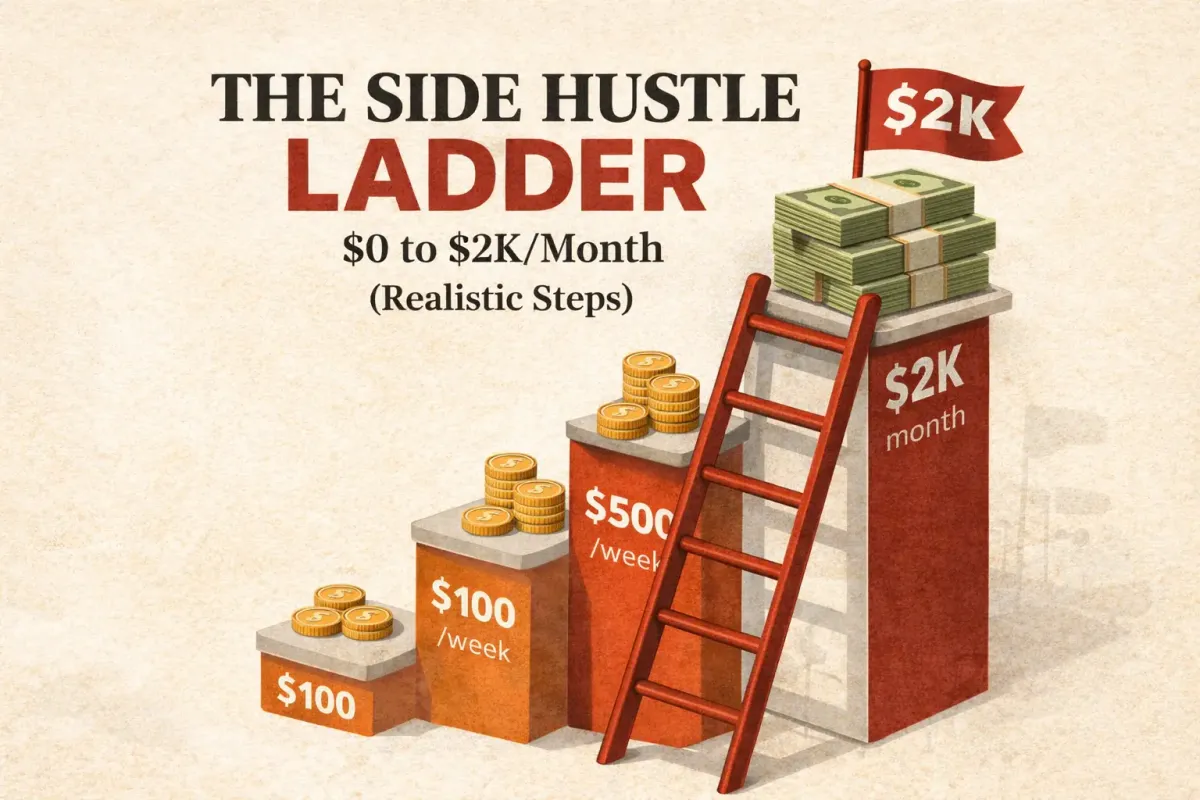
The Side Hustle Ladder: $0 to $2K/Month (Realistic Steps)
Build a realistic side hustle roadmap from $0 to $2K/month. Learn what to focus on at $100/week, $500/week, and beyond—plus simple systems, pricing moves, and the math behind reaching consistent side income without burnout.
Making consistent side hustle income isn’t about discovering a secret opportunity. It’s about building momentum in small, repeatable steps—then improving what already works.
Most beginners get stuck for one of three reasons:
- They chase the “perfect” idea instead of starting with a simple offer.
- They avoid selling, so nothing ever gets validated in the real world.
- They never build systems, so even when they earn, it feels chaotic and exhausting.
That’s why a “ladder” works better than a giant list of hustle ideas. A ladder keeps the focus on the next rung—one clear goal at a time—until reaching a reliable target like $2,000 per month.
This guide is a realistic roadmap from $0 to $2K/month, including what to focus on at:
- $0 → $100/week (first win)
- $100 → $500/week (consistency)
- $500/week → $2K/month (sustainable side income)
It also includes a simple math table showing how $2K/month is built in different models, without hype.
The Side Hustle Ladder Explained (How $0 Becomes $2K/Month)
The ladder concept is simple: income grows when a beginner moves through predictable phases.
What changes as side hustle income grows
At the start, the work is messy and uncertain. As income increases, the work becomes clearer and more efficient.
- Phase 1: Trying things
The beginner is experimenting. The goal is a first win, not perfection. - Phase 2: Selling one offer
The beginner chooses one service or product and repeats it until it works consistently. - Phase 3: Repeating what works
The beginner focuses on a repeatable lead source and a repeatable delivery process. - Phase 4: Increasing value and efficiency
The beginner raises pricing, improves outcomes, and reduces wasted time.
This is why $2K/month is not the first goal. The first goal is proof—because proof turns “maybe” into a predictable system.
The 3 levers of side hustle income
A side hustle can increase earnings through three main levers:
- Volume
More customers, more jobs, more sales. - Price
Better packages, higher rates, stronger positioning. - Efficiency
Less time wasted on admin, travel, and rework—more time spent on paid work.
A beginner often tries to increase volume first. That’s fine, but the ladder works best when all three levers improve gradually.
The honest timeline (what’s realistic)
Every person’s schedule and skill level is different, but realistic time windows usually look like this:
- First income ($0 → $100/week): days to a couple of weeks
- Consistency ($100 → $500/week): a few weeks to a few months
- Sustainable side income ($500/week → $2K/month): usually 1–3 months after consistency begins, sometimes longer depending on the hustle and hours available
The fastest results typically come from services and local hustles, while content-based hustles (like blogging/affiliate) take longer but can build long-term assets.
Before You Start: Set Up the Foundation in 60 Minutes
Beginners don’t need complicated systems, but they do need a basic foundation that reduces friction.
Step 1: Pick the simplest starter hustle
A good starter hustle usually has these traits:
- Low startup cost (or costs that scale with income)
- Fast path to the first customer
- Fits the beginner’s schedule and energy
- Has clear demand
- Doesn’t require expert credentials to start
Beginner-friendly starter categories:
- Local services (cleaning, lawn, detailing, dog walking)
- Reselling/flipping (marketplace)
- Gig work (short-term cashflow)
- Simple online services (VA, editing, basic creative support)
Step 2: Create a one-sentence offer
A beginner should be able to describe the hustle in one sentence. If it takes a paragraph, it’s too vague.
A simple template:
“I help [type of person] get [result] without [pain].”
Examples:
- “I help busy families get a clean home without spending their weekends on it.”
- “I help local businesses post consistently on social media without hiring a full-time marketer.”
- “I help people sell unused items fast without wasting time on back-and-forth messaging.”
The goal is clarity. Clarity makes selling easier.
Step 3: Set up basic systems (no overbuilding)
A beginner only needs:
- Payment method: bank transfer, PayPal, Stripe, or simple invoicing (depending on model)
- Tracking sheet: income, expenses, hours, mileage (if applicable)
- Scheduling: a calendar block for hustle hours
- Message templates: a few copy-paste replies for common questions
- A “no list”: boundaries (minimum job size, distance, times)
A side hustle becomes stressful when the work is random and the boundaries are unclear. A simple setup prevents that.
Ladder Rung 1 — $0 to $100/Week (First Win Stage)
This rung is about one thing: earning the first dollar.
Not because $100/week is the end goal, but because the first win creates momentum and confidence.
The goal at $0 → $100/week
At this stage, beginners should prioritize:
- speed to first income
- simple offers
- real-world validation
- learning through action
This is not the stage for:
- perfect branding
- fancy websites
- complicated funnels
- endless research
Best hustles for $0 → $100/week
These models tend to produce fast wins:
Local services (fastest route)
- Cleaning
- Lawn mowing/yard cleanup
- Dog walking/pet sitting
- Basic car washing/detailing
Why they work: people already pay for these services. The beginner’s job is to show up and deliver.
Reselling (fast wins if done correctly)
- Sell 10 items from home first
- Flip low-risk items from marketplace sources
Why it works: customers already exist and platforms already have traffic.
Gig work (for immediate cashflow)
- Delivery/task apps
- Short-term casual work
Why it helps: it can fund a better long-term hustle. It’s a rung, not a final destination for everyone.
Simple online services (if the beginner is comfortable online)
- Virtual assistant tasks (simple packages)
- Editing/proofreading
- Content posting/scheduling
Why it can work: businesses always need help with repetitive tasks—if the offer is clear.
The 7-day action plan (first win sprint)
A beginner can follow this structure no matter which hustle they pick.
Day 1 — Choose one offer
One service. One outcome. One customer type.
Day 2 — Choose a starter price
It doesn’t need to be perfect. It needs to be reasonable and easy to explain.
Day 3 — Create a simple “how to book” message
A short message that includes:
- what’s included
- price starting point
- service area/availability
- how to book
Day 4 — Outreach (the real start)
- Post in one relevant place
- Send 10–20 messages to warm contacts or likely buyers
- List items if reselling
Day 5 — Follow-up
Most beginners fail because they post once and stop. Follow-up is where results come from.
Day 6 — Deliver the first job/sale
Overdeliver slightly on communication and reliability.
Day 7 — Capture proof
- ask for a review
- take before/after photos (where appropriate)
- save testimonials
The point is to turn the first win into a repeatable pattern.
Common blockers (and how to fix them)
“Selling feels uncomfortable”
A beginner can reframe selling as:
- offering help
- solving a real problem
- providing a clear outcome
The easiest way to sell is to keep it simple and honest.
“Pricing is confusing”
Beginners don’t need perfect pricing. They need:
- a starting price
- a minimum job size
- the ability to adjust after 3–5 real jobs
“There are too many options”
If the beginner can’t pick, they should pick the option with:
- the fastest first sale
- the lowest cost
- the best schedule fit
Momentum beats the perfect choice.
Ladder Rung 2 — $100 to $500/Week (Consistency Stage)
Once a beginner earns $100/week, the next challenge is consistency.
Many people earn a little money once—and then it disappears because they don’t repeat the process.
What to focus on at ~$100/week
At this rung, the main objective is:
Build a repeatable offer + a repeatable lead source.
A beginner should identify:
- which offer got the best response
- where the leads came from
- what was easiest to deliver
Then double down.
Build a simple weekly structure (no burnout)
A consistent side hustle needs a schedule. Even a small one.
Example weekly structure for a busy person:
- 2 days outreach: messages, posts, follow-ups
- 2 days delivery: paid work
- 1 day admin: invoicing, planning, restocking, updates
This prevents the hustle from becoming chaos.
Upgrade pricing with packages (the easiest income jump)
Many beginners stay stuck because they price like amateurs:
- hourly only
- low minimums
- custom work every time
Packages make the hustle easier to sell and more profitable.
Examples:
- Cleaning: “Standard Clean” vs “Deep Clean”
- Detailing: “Interior Refresh” vs “Full Detail”
- VA: “4 hours/week retainer” package
- Editing: “Blog refresh package” for a set fee
Packages help the beginner:
- increase price without feeling awkward
- standardize delivery
- reduce decision fatigue
Add proof and repeat clients (the consistency engine)
Beginners should focus on:
- collecting reviews
- showcasing before/after outcomes
- creating referral incentives (simple: “$10 off next service for referrals”)
- offering recurring slots (weekly/fortnightly)
Repeat customers turn a hustle from random into reliable.
Ladder Rung 3 — $500/Week to $2K/Month (Sustainable Side Income)
This is the stage where many people realize: this is real.
At around $500/week, the hustle has a working engine. Now the goal is to stabilize and optimize.
What to focus on at ~$500/week
At this rung, the biggest improvements usually come from:
- better conversion (more yes responses per outreach)
- higher effective hourly rate
- systems that reduce stress
A beginner should stop chasing new ideas and instead build depth in one lane.
Systems that unlock scale (without “working more”)
A simple system stack often includes:
- Templates
- inquiry response
- pricing explanation
- booking confirmation
- follow-up message
- review request
- Basic CRM (even a spreadsheet)
Track:- leads
- booked jobs
- follow-ups
- repeat customers
- Scheduling rules
- set hustle hours
- limit travel distance
- batch jobs by location/time
- Referral system
Make referrals easy and rewarded.
Increase hourly earnings without working more
There are four main ways to earn more without adding more hours:
- Specialize slightly
Instead of “general cleaning,” focus on “end-of-lease cleaning” or “busy professionals.” - Bundle outcomes
Sell a package that creates a clear result. - Raise prices in small steps
A small raise every 5–10 customers can change income dramatically. - Reduce unpaid time
Travel, admin, and back-and-forth messaging are often the real profit killers.
The $2K/Month Blueprint (Three Proven Ways to Get There)
$2,000/month can be built in multiple models. The key is picking one and following through.
Path A — Services route (fastest for beginners)
Services are often the fastest way to earn a side income because the path is direct:
- offer → customer → payment
$2K/month math table (services)
| Model | Price | Jobs/Clients Needed | Weekly Target |
|---|---|---|---|
| Cleaning (recurring) | $100 per clean | 5 recurring clients/monthly + add-ons | 2–3 jobs/week |
| Lawn/yard | $80 per job | 25 jobs/month | 6–7 jobs/week |
| Detailing (packages) | $150 per job | 14 jobs/month | 3–4 jobs/week |
| VA retainer | $500 per client/month | 4 clients | 1 new client every few weeks |
| Editing/writing package | $250 per project | 8 projects/month | 2 projects/week |
| Tutoring | $50 per session | 40 sessions/month | 10 sessions/week |
A beginner can see that $2K/month is not magic. It’s math—built on consistency and a clear offer.
Path B — Reselling route (cashflow model)
Reselling can hit $2K/month, but it depends on:
- sourcing consistently
- listing consistently
- choosing categories with decent margins
$2K/month math table (reselling)
| Model | Avg Profit per Item | Items Needed per Month | Weekly Target |
|---|---|---|---|
| Small flips | $20 | 100 items | 25 items/week |
| Medium flips | $50 | 40 items | 10 items/week |
| Higher-ticket flips | $100 | 20 items | 5 items/week |
Reselling succeeds when the beginner treats it like a routine:
- source on set days
- list daily or in batches
- respond quickly
- track what actually sells
Path C — Content route (slower, scalable)
Content is slower because:
- it takes time to build traffic
- it takes time to build trust
- income is often delayed
But it can become an asset.
A realistic approach for beginners:
- use a service hustle to fund life and reduce pressure
- build content consistently on the side
- focus on helpful, specific topics, not generic “make money online” content
Example “Ladders” (Realistic Progression Scenarios)
These aren’t promises. They’re illustrative paths that show what a realistic progression can look like.
Ladder Example 1: Local Service (Cleaning or Lawn)
Week 1–2
- Post offer
- Book 1–2 clients
- Get first testimonials
Month 1
- Build recurring schedule (weekly/fortnightly)
- Improve pricing
- Reduce travel time by staying local
Month 2–3
- Add premium package
- Ask for referrals consistently
- Raise prices slightly
- Hit $2K/month with recurring clients
Ladder Example 2: Online Service (VA or Editing)
Week 1
- Create 2–3 portfolio samples
- Write a simple pitch
- Send outreach daily
Weeks 2–4
- Book first client
- Deliver excellent work
- Collect testimonial
- Repeat outreach
Month 2–3
- Shift to retainers
- Build templates and systems
- Hit $2K/month with 3–4 clients
Ladder Example 3: Reselling / Flipping
Week 1
- List 10 items from home
- Make first sales fast
- Learn pricing
Month 1
- Source low-risk items consistently
- Build a listing routine
Month 2–3
- Focus on categories that sell quickly
- Improve photos and descriptions
- Increase volume or margins to reach $2K/month
Common Plateaus (Why People Get Stuck and How to Fix It)
Stuck at $0
Cause: no outreach, no offers shipped
Fix: commit to a 7-day sprint with daily outreach
Stuck at $100/week
Cause: random gigs, no repeat lead source
Fix: choose one lead source and repeat it weekly
Stuck at $500/week
Cause: refusing to raise prices, too much custom work
Fix: standardize packages, raise prices, collect proof
Stuck at $2K/month
Cause: inconsistent schedule, weak systems, burnout
Fix: tighten boundaries, systemize, and protect energy
What to Track (So Side Hustle Income Grows Predictably)
Tracking doesn’t need to be complicated. It needs to be consistent.
The 5 numbers that matter
- Outreach sent (messages, posts, listings, applications)
- Replies/leads (responses that indicate interest)
- Bookings/sales (the real outcome)
- Effective hourly rate (income divided by time invested)
- Net profit (income minus costs)
A simple weekly review (15 minutes)
- What worked this week?
- What didn’t?
- What one change will improve next week?
This keeps the hustle moving forward.
Staying Safe, Legal, and Sane (Without Getting Overwhelmed)
Beginners should keep side hustles sustainable.
Simple recordkeeping habits
- Track income and expenses weekly
- Save receipts
- Track mileage if driving is involved
- Keep notes on pricing and time per job
Avoid scams and “pay-to-get-paid”
A beginner should be cautious with:
- upfront fees
- “guaranteed income”
- pressure tactics
- requests for sensitive information early
Prevent burnout
A sustainable side hustle has:
- clear working hours
- rest days
- boundaries on scope and travel
- gradual growth, not constant intensity
FAQs: The Side Hustle Ladder ($0 to $2K/Month)
How can someone start a side hustle with no money?
Many beginners can start with local services, reselling items they already own, or simple online services using free tools. The key is choosing an offer that can be delivered without large upfront costs.
How long does it take to earn $2K a month from a side hustle?
It varies by hustle and available hours, but many people can reach consistent side income within a few months by focusing on a repeatable offer, consistent outreach, and small pricing improvements.
What side hustles make $2,000 a month?
Services (cleaning, detailing, yard work), online retainers (VA, editing), tutoring, and consistent reselling routines are common ways to reach $2K/month.
How many hours a week does it take to make $2K a month?
It depends on the model and pricing. Higher-value packages can reach $2K/month with fewer hours, while low-margin models require more volume. Many people reach $2K/month with 6–12 hours per week once consistent.
What is the fastest side hustle to start earning?
Local services and reselling tend to be fastest because customers already exist and the path to payment is direct.
What should someone do when a side hustle isn’t working?
They should evaluate whether outreach is consistent, whether the offer is clear, whether pricing is reasonable, and whether they are following up. Most failures come from lack of repetition, not lack of potential.
How can someone increase side hustle income without working more?
They can package offers, raise prices gradually, reduce unpaid time, specialize slightly, and build systems for repeat customers and referrals.
Is $2K a month realistic as a side hustle?
For many people, yes—especially through services and retainers. It requires consistent action, but it’s not an unrealistic target when approached step-by-step.
Conclusion: The Ladder Works Because It Keeps Things Simple
Earning side hustle income is possible for beginners, but it takes effort and consistency. The ladder makes the process realistic:
- $0 → $100/week: get the first win
- $100 → $500/week: build consistency
- $500/week → $2K/month: systemize and stabilize
The next step is simple: pick the rung that matches current reality, then commit to seven days of action. Momentum does the rest.
If a beginner wants weekly progression maps, realistic side hustle ideas, and no-hype playbooks, Hustler Herald is built for exactly that.