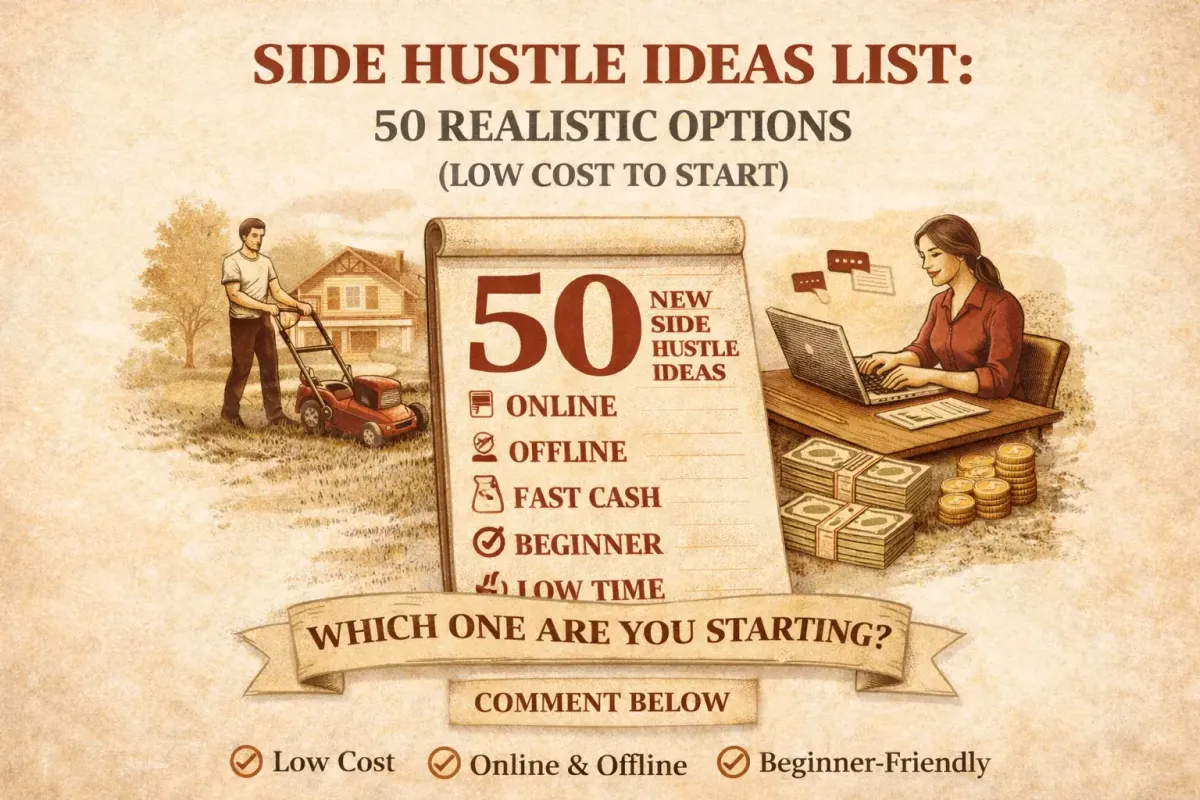
Side Hustle Ideas List: 50 Realistic Options (Low Cost to Start)
A practical list of 50 realistic side hustle ideas you can start with low cost. Online, local, services, and reselling options—sorted by skill level and time—so you can pick one that fits your schedule and get started today.
Starting a side hustle doesn’t require a perfect plan, a big audience, or thousands of dollars in tools. What it does require is picking something realistic—something that fits a real schedule, a real budget, and real energy levels after work.
The internet is full of “side hustle ideas” lists that sound exciting but fall apart when it’s time to actually start. This list is different. It focuses on 50 realistic side hustle options that can be started with low startup cost and scaled up over time.
This guide is written for beginners who want options without overwhelm. It’s designed to help readers quickly filter ideas by:
- Online vs offline
- Skill level
- Time required
- Speed to first income
- Cost to start
At the end, there’s a simple framework to choose the right hustle—and an easy way to take action this week.
Interactive prompt: Comment with the number you’re starting (or considering).
It’s easier to follow through when there’s accountability.
How to Use This Side Hustle Ideas List (Read This First)
This list is most useful when it’s treated like a menu—not a to-do list.
The biggest mistake beginners make
They skim 50 ideas, get motivated, and then pick three. They dabble, burn out, and earn nothing.
A better approach:
- Pick one idea from this list
- Commit to 30 days
- Use small weekly goals (ex: first $100)
- Decide whether to double down or switch after real effort
Quick legend (use these mental labels)
Not every hustle is equal. While reading, think in categories:
- Online side hustle: remote-friendly, computer-based
- Offline side hustle: local, hands-on, in-person work
- Fast cash: can earn quickly with outreach and delivery
- Long-term: slower start but can compound over time
- Low time: fits in 3–6 hours per week
- Skill-based: requires a usable skill (not necessarily credentials)
Simple filter questions (choose your path fast)
- Does money need to happen this week, or is a longer ramp okay?
- Is the schedule better for after work or weekends?
- Is the side hustler comfortable with clients, or does content feel better?
- Is the preference online or local?
Once those questions are answered, the right ideas jump out.
Online Side Hustle Ideas (Low Cost, Remote-Friendly)
Online side hustles tend to be popular because they’re flexible. They can often be done after work, on weekends, or in short blocks. Many can start with nothing more than a laptop, internet connection, and basic consistency.
Below are 20 realistic online side hustle ideas with low startup cost.
1) Freelance Writing
What it is: Writing blog posts, newsletters, landing pages, product descriptions, or website content for businesses.
Why it works: Businesses need content constantly, and writing is one of the easiest “sell a skill” options.
Startup cost: Low (often $0).
Time to first income: Fast if outreach happens (days to weeks).
Best for: People who can write clearly and follow instructions.
2) Virtual Assistant (VA) Services
What it is: Admin support like scheduling, inbox management, customer support, research, or small tasks for busy business owners.
Why it works: Many small businesses don’t need full-time staff, but they need help.
Startup cost: Low.
Time to first income: Fast (weeks) with consistent outreach.
Best for: Organized people who like checklists and systems.
3) Editing and Proofreading
What it is: Fixing grammar, structure, clarity, and formatting for blog posts, resumes, ebooks, or newsletters.
Why it works: People create content but don’t want to polish it.
Startup cost: Low.
Time to first income: Moderate-fast.
Best for: Detail-oriented people with strong written English.
4) Canva Design Services
What it is: Creating simple graphics—social posts, flyers, thumbnails, banners, and basic brand templates.
Why it works: Canva makes design accessible, and many businesses want “good enough” visuals quickly.
Startup cost: Low (free or low-cost subscription).
Time to first income: Fast if packaged well.
Best for: People with visual taste and consistency.
5) Content Repurposing (Long → Short)
What it is: Turning one long piece (podcast, YouTube, blog) into multiple short social posts.
Why it works: Creators and businesses need volume across platforms, and repurposing saves time.
Startup cost: Low.
Time to first income: Fast with the right niche.
Best for: People who can summarize clearly and write short hooks.
6) Social Media Scheduling Support
What it is: Planning and scheduling posts using tools (or native scheduling).
Why it works: Consistency wins online, but owners don’t want to do it daily.
Startup cost: Low.
Time to first income: Moderate-fast.
Best for: People who are consistent and comfortable with repetitive tasks.
7) Resume and LinkedIn Profile Cleanup
What it is: Improving resumes and LinkedIn profiles for clarity, formatting, and keywords.
Why it works: Job seekers want results quickly and will pay for a professional look.
Startup cost: Low.
Time to first income: Fast with direct outreach in job seeker communities.
Best for: People who can write professionally and format cleanly.
8) Online Tutoring
What it is: Teaching school subjects, languages, or beginner skills through video calls.
Why it works: Tutoring is always in demand and can be scheduled around a 9–5.
Startup cost: Low.
Time to first income: Moderate.
Best for: Patient communicators with strong knowledge in one area.
9) Simple Website Updates
What it is: Basic website help—fixing broken pages, updating text/images, adding forms, setting up simple SEO basics.
Why it works: Many business sites are outdated and owners don’t want to touch them.
Startup cost: Low.
Time to first income: Moderate-fast.
Best for: People comfortable with WordPress, Squarespace, or basic web tools.
10) No-Code Website Builds
What it is: Creating simple websites using platforms like Squarespace, Webflow, or WordPress themes.
Why it works: Small businesses need websites without developer complexity.
Startup cost: Low to moderate.
Time to first income: Moderate.
Best for: People who like structured building and templates.
11) Affiliate Blogging (Beginner Version)
What it is: Publishing helpful content and earning commissions when readers buy through links.
Why it works: Content can compound and earn over time.
Startup cost: Low to moderate (domain/hosting optional early).
Time to first income: Slow (often months).
Best for: Patient builders who like writing and research.
12) Niche Newsletter
What it is: A weekly email focused on one niche (tools, deals, trends, lessons).
Why it works: Email builds a direct audience and can be monetized later.
Startup cost: Low.
Time to first income: Moderate-slow unless an audience already exists.
Best for: People who can publish consistently.
13) Podcast Editing (Beginner Level)
What it is: Cleaning audio, trimming, adding intros/outros, exporting files.
Why it works: Podcast production is time-consuming for creators.
Startup cost: Low to moderate (software).
Time to first income: Moderate.
Best for: People comfortable learning tools and working with files.
14) YouTube Thumbnail and Title Support
What it is: Helping creators with thumbnails, titles, and upload packaging.
Why it works: Click-through matters, and creators want help.
Startup cost: Low.
Time to first income: Moderate.
Best for: People with marketing instincts and visual taste.
15) Online Research Services
What it is: Finding information, summarizing competitors, compiling lists, collecting leads.
Why it works: Businesses pay for time saved.
Startup cost: Low.
Time to first income: Moderate-fast.
Best for: People who are thorough and can present clean results.
16) Data Entry (Legit Use Cases)
What it is: Cleaning spreadsheets, organizing records, migrating data between systems.
Why it works: It’s not glamorous, but it’s needed.
Startup cost: Low.
Time to first income: Moderate.
Best for: People who are careful and consistent.
17) Inbox Cleanup and Organization
What it is: Organizing inboxes, setting folders/rules, unsubscribing, creating templates.
Why it works: Email chaos is common and stressful.
Startup cost: Low.
Time to first income: Fast with a clear package.
Best for: Organized people who like systems.
18) Digital Templates (Notion, Docs, Spreadsheets)
What it is: Building templates people can buy—trackers, planners, dashboards.
Why it works: Templates are low-cost to create and can be sold repeatedly.
Startup cost: Low.
Time to first income: Moderate.
Best for: People who like building systems and simplifying workflows.
19) Stock Photo or Video Creation (Beginner-Friendly Niches)
What it is: Creating simple lifestyle or business-related images/videos for stock platforms.
Why it works: Content libraries need constant supply.
Startup cost: Low to moderate (phone camera can work).
Time to first income: Slow.
Best for: People who enjoy content creation and have patience.
20) Print-on-Demand Designs
What it is: Selling t-shirts, mugs, posters via platforms that handle printing/shipping.
Why it works: Low inventory risk.
Startup cost: Low.
Time to first income: Moderate-slow.
Best for: People who can create simple designs and market them.
Offline / Local Side Hustle Ideas (Fastest to Cash)
Offline hustles often win for beginners because they don’t require a following or complicated tech. They rely on local demand—and local demand is very real.
21) House Cleaning
What it is: General cleaning for homes or apartments.
Why it works: Repeat demand and easy referrals.
Startup cost: Low (basic supplies).
Time to first income: Fast.
Best for: People who want predictable, repeatable work.
22) End-of-Lease / Move-Out Cleaning (Beginner Version)
What it is: Deeper cleaning for renters moving out.
Why it works: People are time-poor and need help fast.
Startup cost: Low to moderate.
Time to first income: Fast.
Best for: People who can handle bigger jobs and checklists.
23) Lawn Mowing
What it is: Regular mowing and basic yard maintenance.
Why it works: Simple offer, easy upsells.
Startup cost: Low if equipment exists.
Time to first income: Fast.
Best for: People who don’t mind outdoor work.
24) Garden Tidy-Ups
What it is: Weeding, trimming, basic yard cleanup.
Why it works: Great add-on to mowing.
Startup cost: Low.
Time to first income: Fast.
Best for: People who like physical work and visible results.
25) Pressure Washing
What it is: Cleaning driveways, patios, outdoor surfaces.
Why it works: Before/after results sell themselves.
Startup cost: Moderate (equipment).
Time to first income: Fast once equipped.
Best for: People who want high-impact local jobs.
26) Dog Walking
What it is: Regular walking services.
Why it works: Repeat schedule and recurring income.
Startup cost: Low.
Time to first income: Fast.
Best for: Reliable people with a consistent schedule.
27) Pet Sitting
What it is: Caring for pets while owners travel.
Why it works: High trust + strong demand.
Startup cost: Low.
Time to first income: Moderate-fast.
Best for: Pet lovers who can build trust.
28) Babysitting (Where Appropriate)
What it is: Childcare services for parents.
Why it works: High demand, but requires trust and responsibility.
Startup cost: Low.
Time to first income: Moderate.
Best for: People with experience and strong references.
29) Moving Help / Heavy Lifting
What it is: Helping people move or lift heavy items.
Why it works: People often need short-term muscle.
Startup cost: Low.
Time to first income: Fast.
Best for: People comfortable with physical work.
30) Junk Removal / Decluttering Help
What it is: Helping people clear out garages, spare rooms, and clutter.
Why it works: Demand is high and jobs can be profitable.
Startup cost: Low to moderate (vehicle helps).
Time to first income: Fast.
Best for: People who like visible transformations.
31) Car Detailing Basics
What it is: Interior cleaning and basic detailing.
Why it works: Good margin, repeat customers possible.
Startup cost: Low to moderate.
Time to first income: Fast.
Best for: People with attention to detail.
32) Basic Handyman Tasks (Within Skill Level)
What it is: Simple fixes like assembling furniture, hanging shelves, basic repairs.
Why it works: People pay for time saved.
Startup cost: Low (basic tools).
Time to first income: Fast.
Best for: Practical people who can follow instructions.
33) Window Cleaning
What it is: Cleaning windows for homes or small businesses.
Why it works: Simple service, repeat schedule potential.
Startup cost: Low.
Time to first income: Fast.
Best for: People who like routine work.
34) Local Tutoring
What it is: Teaching a subject locally (school, music, languages).
Why it works: Parents pay for improvement.
Startup cost: Low.
Time to first income: Moderate.
Best for: Patient teachers.
35) Event Setup / Pack-Down Help
What it is: Helping at events with setup and cleanup.
Why it works: High demand for temporary help.
Startup cost: Low.
Time to first income: Moderate-fast.
Best for: People willing to work evenings/weekends.
Reselling & Flipping Side Hustles (Beginner-Friendly + Proven Demand)
Reselling is one of the best entry points for people who don’t want clients. It’s simple: buy low (or free), sell higher, repeat.
36) Facebook Marketplace Flipping
What it is: Buying and selling items locally.
Why it works: Massive local demand.
Startup cost: Low.
Time to first income: Fast.
Best for: People who can negotiate and move quickly.
37) Thrift Store Reselling
What it is: Finding undervalued items and selling online.
Why it works: Fashion and collectibles can have strong margins.
Startup cost: Low.
Time to first income: Moderate.
Best for: People willing to learn what sells.
38) Garage Sale Flipping
What it is: Weekend sourcing from garage sales.
Why it works: Prices are often low and negotiable.
Startup cost: Low.
Time to first income: Fast.
Best for: People who enjoy hunting deals.
39) Book Reselling
What it is: Selling used books via marketplaces.
Why it works: Books are easy to store and ship.
Startup cost: Low.
Time to first income: Moderate.
Best for: People who like scanning and listing efficiently.
40) Sneaker Flipping (Beginner Caution)
What it is: Buying sneakers in demand and reselling.
Why it works: Strong market, but requires knowledge.
Startup cost: Moderate.
Time to first income: Moderate.
Best for: People who can research trends.
41) Furniture Flipping
What it is: Fixing up used furniture and reselling.
Why it works: Big profit potential with basic repairs.
Startup cost: Low to moderate.
Time to first income: Moderate.
Best for: People with space and basic DIY skills.
42) Electronics Resale
What it is: Buying used electronics and reselling after cleaning/testing.
Why it works: Constant demand.
Startup cost: Moderate.
Time to first income: Moderate.
Best for: People comfortable testing devices.
43) Local Demand Items Resale
What it is: Reselling items that are consistently needed locally (baby items, gym gear, tools).
Why it works: Predictable demand.
Startup cost: Low.
Time to first income: Fast.
Best for: People who want simple repeat patterns.
Content & Affiliate Side Hustles (Longer-Term Plays)
These can become powerful, but they require consistency. They’re best for people who can stick with a plan even when results are slow.
44) Affiliate Niche Website
What it is: A website focused on one niche with product recommendations.
Why it works: Search traffic can compound.
Startup cost: Low to moderate.
Time to first income: Slow.
Best for: Patient writers who like research.
45) Review Blog
What it is: Writing reviews of products/services in a niche.
Why it works: People search before buying.
Startup cost: Low.
Time to first income: Slow to moderate.
Best for: People who can write balanced reviews.
46) Comparison Blog (“X vs Y”)
What it is: Comparing products/services and helping readers decide.
Why it works: High intent searches.
Startup cost: Low.
Time to first income: Moderate-slow.
Best for: People who can organize pros/cons clearly.
47) TikTok Affiliate Videos (Beginner-Friendly)
What it is: Short product demos or recommendations.
Why it works: Fast distribution potential.
Startup cost: Low.
Time to first income: Moderate (depends on reach).
Best for: People comfortable on camera.
48) Instagram Theme Page
What it is: Curated content around a niche with affiliate links.
Why it works: Can grow a dedicated audience.
Startup cost: Low.
Time to first income: Moderate-slow.
Best for: People consistent with daily posts.
49) YouTube Niche Channel
What it is: Videos teaching, reviewing, or demonstrating within a niche.
Why it works: Strong long-term discovery.
Startup cost: Low to moderate.
Time to first income: Slow to moderate.
Best for: People who can commit to weekly output.
50) Newsletter With Affiliate Offers
What it is: Email content plus relevant product/tool recommendations.
Why it works: Email builds trust and repeat clicks.
Startup cost: Low.
Time to first income: Moderate-slow.
Best for: People who can write weekly.
How to Pick the Right Side Hustle From This List
Choosing well is about matching the hustle to life—not fantasy.
Use this simple decision framework
1) How fast is income needed?
- Fast cash: local services or flipping
- Medium speed: online services
- Long-term: affiliate/content
2) How much time is available per week?
- 3–5 hours: simple local jobs or one online package
- 5–10 hours: consistent client work or content cadence
- 10+ hours: more options, faster growth
3) Is the preference online or offline?
- Prefer offline: pick a local service with repeat demand
- Prefer online: pick one skill and package it
4) Does the side hustler want clients or content?
- Clients: faster money, more interaction
- Content: slower money, more leverage
5) Is visibility comfortable?
- Comfortable: video/content can work
- Not comfortable: services and reselling are great
Common Mistakes When Choosing a Side Hustle
Choosing based on hype
If it sounds too good to be true, it usually is.
Ignoring schedule reality
A hustle that requires daily availability won’t work for someone with a packed schedule.
Underpricing
Low prices attract tough customers and lead to burnout.
Switching too quickly
A week is not enough to judge most models.
Overbuilding before selling
Logos and websites don’t create revenue. Offers and outreach do.
How to Start Any Side Hustle From This List (Simple Steps)
Regardless of which idea is chosen, the launch steps look similar:
- Pick one idea
- Define a $100 goal
- Create a simple offer
- Post or outreach
- Deliver and collect proof
- Repeat weekly
A beginner who repeats these basics will almost always beat someone who plans endlessly.
FAQs: Side Hustle Ideas (Beginner Questions)
What is the easiest side hustle to start?
Local services and basic reselling are often easiest because they don’t require advanced skills or a big setup.
What side hustle makes money the fastest?
Local services like cleaning, lawn mowing, and moving help are usually among the fastest paths to first income.
Can a side hustle be started with no money?
Yes. Many online services and local services can start with existing tools and simple outreach.
Are online side hustles legit?
Yes, but results come from delivering value and finding customers—avoid anything that promises guaranteed income without work.
How much can a side hustle realistically make?
It depends on time, skill, and consistency. Many beginners aim for $100–$500 per week as a realistic early milestone.
Final Thoughts (and the Comment Challenge)
This list isn’t meant to be read once and forgotten. It’s meant to be used.
Pick one number. Commit for 30 days. That’s how people actually get results.
Comment with the number you’re starting this week.
Even better: comment your schedule (after work / weekends) and whether you want online or offline, and Hustler Herald readers can suggest the best match.