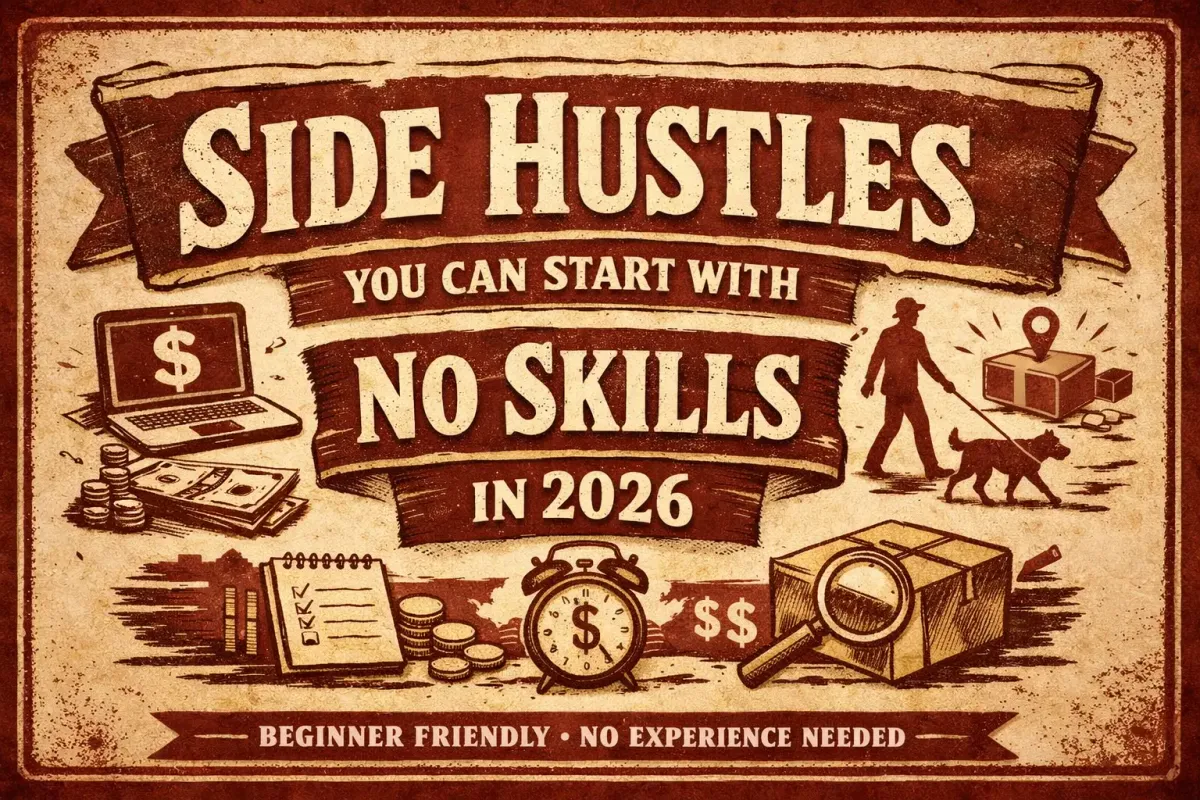
Side Hustles You Can Start With No Skills in 2026
No skills? No problem. This beginner guide to no-skill side hustles in 2026 covers easy online + offline options, how to land your first customer, simple pricing, and a 30-day plan to reach your first $500.
Starting a side hustle in 2026 doesn’t require special talent, a fancy certification, or a huge social following. What it does require is a realistic plan, a simple offer, and the willingness to start small—then improve as results (and confidence) build.
The internet is full of “overnight success” stories, but most beginners don’t need hype. They need no-skill side hustles that are easy to start, hard to mess up, and capable of turning into real income with repetition.
This guide breaks down the best no-skill side hustles for 2026—both online and offline—plus the exact steps to land the first customer, price services without guessing, avoid common scams, and turn “no experience income” into something consistent.
What “No-Skill Side Hustles” Really Means (And What It Doesn’t)
The phrase no-skill side hustles can be misleading. Almost every hustle requires something—time, reliability, basic communication, and the ability to follow a simple process. In this guide, “no-skill” means:
- No credentials required (no degree, license, or formal training)
- No portfolio required to start (proof can be created quickly)
- Minimal setup (no complex tools, expensive equipment, or big risk)
- Skills can be learned in days, not months (templates + repetition do the heavy lifting)
- Beginner-friendly customer expectations (simple deliverables, clear outcomes)
What it does not mean:
- “Press a button and get paid”
- “Guaranteed easy money”
- “Zero effort forever”
- “Instant high income without building trust”
The smartest beginner approach is to treat a side hustle like a ladder:
- Start with a simple offer that’s easy to deliver
- Get reps, testimonials, and confidence
- Stack skills naturally (and raise prices as value increases)
That’s how “no experience income” turns into real earnings.
Why Starting a Side Hustle Is Easier in 2026
2026 is one of the best times in history to start as a beginner because the barriers are lower than ever:
1) Tools Make Beginners Look More Professional
Templates, automation, and AI-assisted workflows help beginners create decent deliverables quickly—without needing years of experience. This is especially helpful for basic design, content repurposing, admin tasks, and simple research.
2) Platforms Provide Instant Demand (If Used Properly)
Platforms and marketplaces aren’t perfect, but they help beginners find customers quickly. The tradeoff is competition and platform fees—but as a launchpad, they reduce the “where do I find customers?” problem.
3) Local Services Still Win on Trust
Online businesses are crowded, but local “easy hustles” often come down to reliability. Many people will pay for help if the provider shows up, communicates clearly, and does what they said they would do.
4) People Want Convenience More Than Ever
Busy schedules, remote work, and rising life admin create demand for services that remove friction—cleaning, errands, pet care, basic content tasks, and lightweight admin support.
The key advantage in 2026 is simple: beginners can start faster, earn sooner, and improve while earning.
The Beginner Side Hustles Filter (Pick the Right One Fast)
Most beginners fail not because the hustle is “bad,” but because they pick something that doesn’t fit their lifestyle.
Use this quick filter and score each idea from 1–5:
Time Available
- 30–60 minutes/day: microtasks, repurposing, basic admin, reselling
- Weekends only: cleaning, yard help, events, mobile car wash
- Flexible weekdays: errands, pet sitting, waiting services
Comfort Level
- People-facing: cleaning, pet care, errands, event help
- Behind-the-screen: VA tasks, spreadsheets, content repurposing, templates
Startup Cost
- $0–$50: VA tasks, microtasks, user testing, research lists
- <$100: reselling, basic cleaning supplies, simple car wash kit
- $100–$500: higher capacity reselling, better gear, advertising tests
Speed to First Dollar
- Today/this week: local services, microtasks, user testing
- 1–4 weeks: VA work, content repurposing, simple Canva gigs
- 1–3 months: templates, digital products, higher leverage paths
Repeatability (The Secret to Stability)
- High repeat: cleaning, VA retainers, pet care, content repurposing
- Low repeat: one-off gigs without upsells
Beginner rule: pick one hustle for 30 days. Momentum beats variety.
How to Start a No-Skill Side Hustle in 24 Hours (Simple Plan)
Beginners get stuck because they overthink. The goal isn’t to “find the perfect hustle.” The goal is to start a small offer and get the first proof.
Step 1: Choose One Offer (Not a List of Ideas)
Pick something that can be delivered with a repeatable process.
Examples:
- “I’ll clean kitchens and bathrooms in under 2 hours.”
- “I’ll turn one long video into 10 short clips.”
- “I’ll organize your inbox and calendar for the week.”
- “I’ll create 15 social posts using Canva templates.”
Step 2: Create Proof Fast (Even Without Clients)
Proof doesn’t need to be complicated. It can be:
- A sample before/after (inbox, spreadsheet, Canva post)
- A mock project (a pretend client)
- A checklist showing the process
Step 3: Choose One Customer Source
Pick one:
- Platforms (fast exposure)
- Local community (trust)
- Direct outreach (high upside)
Step 4: Set a Tiny Goal
Don’t aim for a full-time income on day one. Aim for:
- First $50–$100
- First testimonial
- First repeat booking
That’s how the machine starts.
Easy Online Side Hustles With No Skills (Start From Home)
Online beginner side hustles work best when they have clear outcomes and repeatable deliverables. These are the ones that beginners can start quickly in 2026.
1) AI-Assisted Virtual Assistant (Entry-Level Support)
A virtual assistant (VA) helps with basic tasks that busy people avoid. The “no skill” version isn’t high-level operations. It’s simple execution.
Why it’s beginner-friendly
- Many tasks are straightforward and checklist-based
- Business owners often just want someone reliable
- Skills improve quickly with repetition
What beginners can offer
- Inbox cleanup (sort, label, unsubscribe, draft replies)
- Calendar scheduling
- Simple research (find tools, suppliers, competitors)
- Uploading blog posts, formatting, basic editing
- Data entry and CRM cleanup
- Creating simple SOPs (step-by-step docs)
What’s needed
- Laptop, internet, basic communication
- A simple process (checklists)
- A clean way to track tasks (a shared doc or Trello board)
First steps (today)
- Pick one niche of VA work (email + calendar is enough)
- Create a one-page offer:
- “Weekly Admin Reset: Inbox cleanup + calendar planning”
- Make a sample:
- Show an example inbox organization or mock workflow
- Offer a paid trial:
- 2 hours for a fixed price
Where to find customers
- Local business owners
- Solo operators (agents, coaches, consultants, tradies)
- Online communities where people ask for admin help
Pricing (beginner-friendly)
- Fixed starter packages are easier than hourly:
- 2 hours weekly support
- “Inbox reset” one-time service
- Monthly “admin bundle”
How to scale
- Move clients to retainers
- Add simple automation (templates, recurring systems)
- Specialize into one area (ops support, scheduling, CRM cleanup)
2) Short-Form Content Repurposing (Clips, Captions, Carousels)
Content repurposing turns one piece of content into many. It’s ideal for beginners because the “ideas” already exist—the job is packaging.
Why it’s beginner-friendly
- Clear deliverables (X clips, Y captions)
- Easy to systemize
- Many creators and businesses need it
What beginners can offer
- Turn one podcast/video into 8–15 short clips
- Write captions with hooks and calls-to-action
- Convert a blog post into a carousel
What’s needed
- Basic editing tool (mobile or desktop)
- A simple workflow checklist
- Template captions and hooks
First steps
- Pick one deliverable:
- “10 clips + captions from one long video”
- Create sample clips from public content (as a demo)
- Build a simple portfolio page (even a Google doc works)
- Offer a small paid trial:
- 3 clips for a fixed price
Pricing ideas
- Starter bundles are easier:
- 10 clips/week
- 20 clips/month
- Add-ons: subtitles, thumbnails, posting schedule
How to scale
- Batch workflows
- Create reusable hook libraries
- Offer monthly packages (retainers)
3) Spreadsheet Fixing + Data Cleanup
Many people have messy spreadsheets. Beginners can offer “cleanup and organization” as a service.
Why it’s beginner-friendly
- The work is mostly formatting and tidying
- Clients feel immediate relief
- Easy to show before/after
What beginners can do
- Remove duplicates
- Clean columns and formats
- Add filters and sorting
- Basic dashboards (simple summary totals)
- Turn chaos into a clean tracker
What’s needed
- Google Sheets or Excel
- A checklist
- Example before/after images (blur sensitive info)
First steps
- Make a sample spreadsheet makeover
- Offer:
- “Spreadsheet cleanup in 24 hours”
- Reach out to small businesses that track leads, inventory, or bookings
Pricing
- Per spreadsheet (size-based tiers)
- Add-ons: monthly maintenance, template setup
Scale
- Sell templates after learning patterns
- Build recurring maintenance packages
4) Simple Canva Design Gigs (Template-Based)
This isn’t “become a designer.” It’s “use templates well.”
Beginner-friendly offers
- Social posts for local businesses
- Simple flyers
- Menus
- Real estate open home cards
- Event posters
How to deliver without design skills
- Use pre-made templates
- Stick to brand colors and consistent fonts
- Deliver batches (e.g., 15 posts at once)
How to get customers
- Local cafes, gyms, salons, trades
- Offer a starter pack:
- “15 posts + 5 story templates”
Pricing
- Bundle pricing works best (avoid endless revisions)
- Include a revision limit
Scale
- Monthly content packages
- Add simple scheduling support
5) UGC (User-Generated Content) for Brands (No Influencer Needed)
UGC is content that looks authentic and product-focused. Beginners don’t need a huge audience—brands want usable videos.
Beginner-friendly angle
- UGC is about content production, not influence
- Brands often provide guidelines
What beginners can do
- Unboxings
- Product demos
- “3 reasons why…” style videos
- Testimonials-style scripts
What’s needed
- Phone camera
- Natural lighting
- Basic editing app
Getting customers
- Reach out to small brands
- Apply to UGC marketplaces
- Pitch:
- “3 videos + 5 photos for your product page and ads”
Pricing
- Start with a small pack to build proof
- Raise prices after 3–5 successful projects
Scale
- Build repeat brand relationships
- Specialize in a niche category (fitness, home, beauty, food)
6) Lead List Building (Simple Research → Sell to Businesses)
Businesses pay for lists because research is time-consuming.
Beginner-friendly offers
- “List 100 local venues that host events”
- “List 200 businesses in a niche with contact details”
- “Compile 50 suppliers and price points”
What’s needed
- Good research habits
- Clean spreadsheet formatting
How to get customers
- Agencies, recruiters, sales teams, local businesses
- Pitch a small paid trial list
Pricing
- Price per lead or per list size
- Add-ons: verification, segmentation, notes
Scale
- Turn lists into recurring monthly delivery
- Offer “fresh leads monthly” subscriptions
7) Selling Digital Templates (Notion, Checklists, Trackers)
Templates aren’t a fast payday for most beginners, but they’re a strong “build once, sell many” path.
Beginner-friendly templates
- Budget trackers
- Cleaning schedules
- Meal planners
- Client onboarding checklists
- Side hustle planners
First steps
- Create one template that solves a real pain
- Write a simple setup guide
- Sell it on a marketplace
- Promote it with short content examples
Pricing
- Keep it affordable at first
- Bundle multiple templates later
Scale
- Build a “template ecosystem” around a niche
- Add a newsletter or community later
8) Online Reselling (Beginner Flipping)
Reselling is one of the most accessible beginner side hustles because it’s based on effort and consistency.
Beginner-friendly strategies
- Buy low locally, sell for fair value
- Bundle items into “lots”
- Focus on categories with stable demand
What’s needed
- A marketplace account
- Basic photo and listing skills
- Pickup/drop-off routines
First steps
- Start with household items already owned
- Reinvest profits slowly
- Track costs and time
Scale
- Specialize in one category
- Improve listing quality
- Create repeat sourcing routines
9) Microtasks + User Testing (Fast Start, Lower Ceiling)
These are best as starter income, not a forever plan.
Examples
- User testing websites and apps
- Simple annotation tasks
- Surveys (selectively)
Why beginners use this
- Quick learning
- Builds the “I can earn online” habit
How to make it worthwhile
- Set time blocks
- Prioritize higher-paying tasks
- Use it as a bridge while building a better hustle
Easy Offline Side Hustles With No Skills (Local Trust = Fast Wins)
Offline beginner side hustles often outperform online ones in the beginning because competition is lower and trust spreads quickly through neighborhoods.
1) House Cleaning (Simple Systems, Repeat Clients)
Cleaning is one of the most reliable beginner side hustles because it solves an immediate pain.
Why it works
- High demand
- Repeat bookings
- Referrals are common
Beginner-friendly offer
- “Kitchen + bathroom reset”
- “Two-hour weekly clean”
- “Move-out tidy (light version)”
How to start
- Create a checklist
- Bring basic supplies
- Take before/after photos (with permission)
Pricing
- Start with a clear package price
- Charge extra for deep tasks
Scale
- Build recurring clients
- Add upsells (oven clean, windows)
- Eventually outsource or hire
2) Dog Walking / Pet Sitting
Pet care is high-trust and referral-heavy.
Beginner-friendly services
- Daily walks
- Weekend sitting
- Drop-in feeding and check-ins
First steps
- Create a simple service menu
- Ask for referrals from friends/neighbors
- Use clear communication and updates
Pricing
- Per walk / per visit / per night
- Add-ons: extra pets, longer visits
Scale
- Repeat clients
- Build a neighborhood route
- Partner with local vets/groomers
3) Errands + “Waiting-in-Line” Services
People pay to reclaim time.
Beginner-friendly offers
- Grocery pickup and delivery
- Post office returns
- Appointment waiting
- Local pickup/drop-off jobs
Pricing
- Flat fee + mileage
- Or hourly with a minimum
Scale
- Turn it into “weekly errands” retainers
- Bundle with light admin help
4) Yard Help (Weeding, Cleanup, Simple Maintenance)
This is not landscaping—just basic yard relief.
Beginner-friendly services
- Weeding and tidy-ups
- Leaf cleanup
- Basic pruning (if safe and permitted)
- Green waste removal
Pricing
- Per hour with a minimum
- Or package by yard size
Scale
- Repeat seasonal work
- Bundle with pressure washing or cleanup
5) Junk Removal “Lite”
Beginners can start without heavy equipment by focusing on lighter jobs.
Beginner-friendly approach
- Small loads
- Tip runs
- Marketplace pickup and disposal
Pricing
- Minimum pickup fee
- Add disposal costs transparently
Scale
- Partner with a trailer owner
- Add routes and repeat clients
6) Event Help (Setup / Packdown / Staffing)
Weekend events need reliable hands.
Beginner-friendly roles
- Setup crew
- Packdown crew
- Basic ushering
- Vendor help
How to start
- Contact venues and small event companies
- Offer availability and reliability
Scale
- Get on repeat rosters
- Move into coordination roles later
7) Mobile Car Wash (Basic Exterior + Vacuum)
Simple car cleaning sells well in suburban areas.
Beginner-friendly offer
- Exterior wash + interior vacuum
- Add-ons: tire shine, quick detail
Pricing
- Clear tiered packages (small/medium/large vehicles)
Scale
- Route scheduling
- Subscription plans (monthly wash)
How to Get the First Customer With No Skills or Followers
Beginners often think they need a big audience. They don’t. They need proof, clarity, and consistent outreach.
Best beginner customer sources (choose one)
1) Platforms (fastest)
- Great for finding demand quickly
- Good for early testimonials
2) Local community (highest trust)
- Community boards
- Local Facebook groups
- Friends and neighbors (start here)
3) Direct outreach (highest upside)
- Small businesses are busy
- A simple, respectful pitch can work well
The “Proof Beats Pitch” Strategy
Instead of convincing people with words, show them something.
Examples:
- A sample clip with captions
- A cleaned-up spreadsheet demo
- A Canva post set
- A cleaning checklist and a photo of supplies ready to go
Beginner edge: reliable + clear + fast response.
Pricing for Beginners (Without Undercharging Forever)
Beginners often make two pricing mistakes:
- Charging too little and burning out
- Charging too much without proof and getting no sales
The solution is a tiered system.
Starter pricing rules
- Use packages with clear scope
- Include a revision limit
- Offer small paid trials
Simple tier example (works for many hustles)
- Basic: entry deliverable (small)
- Standard: the “best value” option
- Premium: faster turnaround + extras
When to raise prices
- After 3–5 successful jobs
- After testimonials
- After repeat clients appear
The Skill-Stacking Path (Turn Easy Hustles Into Higher Pay)
No-skill side hustles are starting points. The goal is to climb.
The 3-step ladder
- Execution work (beginner-friendly)
- Done-with-you support (more guidance, higher value)
- Specialization (higher ticket, better clients)
Examples:
- VA → operations support → automation setup
- Repurposing → content system → strategy + planning
- Cleaning → premium packages → small team routes
This is how a beginner hustle becomes a real income stream.
Avoid Scams and “Too Good to Be True” Offers
Beginners are targeted by scams because they want certainty.
Red flags
- “Pay to apply”
- “Guaranteed income”
- “We’ll teach you everything—just buy this expensive program”
- Vague descriptions and pressure tactics
Safer approach
- Start with services that create value quickly
- Earn first, then invest in better tools
- Use simple agreements and clear communication
A 30-Day Beginner Plan (From Zero to First $500)
Consistency beats intensity.
Week 1: Choose + Build Proof + Outreach
- Pick one offer
- Create a sample
- Message 10–20 people or businesses
Week 2: First Jobs + Testimonials
- Deliver fast and clean
- Ask for a short testimonial
- Improve the checklist
Week 3: Systemize + Raise Slightly
- Turn the workflow into steps
- Increase price modestly
- Offer a package option
Week 4: Lock Repeat Work
- Pitch a weekly/monthly option
- Create an upsell
- Focus on one acquisition channel
By day 30, a beginner should have:
- Proof samples
- 1–3 testimonials
- A clearer offer
- A repeatable process
FAQs About No-Skill Side Hustles in 2026
What is the easiest side hustle to start with no skills?
The easiest side hustle is one with clear deliverables and fast demand, such as house cleaning, dog walking, basic admin support, content repurposing, or simple reselling. Beginners should choose one offer, create a small sample, and focus on one customer source for 30 days.
What side hustle makes the most money for beginners?
For most beginners, the fastest path to meaningful income comes from repeatable services—cleaning, VA retainers, content repurposing packages, or local routes like pet care. Digital products can scale higher long-term, but services usually pay faster early on.
Can someone start a side hustle with no experience and still succeed?
Yes. Most successful beginners start with a simple offer and learn by doing. The key is choosing a hustle that is easy to deliver consistently, getting early testimonials, and improving the workflow over time instead of waiting to feel “ready.”
How can beginners make extra money in 2026 without special skills?
Beginners can earn extra money by focusing on services that remove friction for others: admin help, content packaging, cleaning, errands, pet care, yard tidy-ups, basic reselling, and lead list building. These hustles rely more on reliability and process than expertise.
Are no-skill side hustles real, or are they scams?
Many no-skill side hustles are real, but scams often disguise themselves as “guaranteed income.” Real opportunities usually involve delivering a service, selling a product, or completing tasks that create value. If someone demands payment upfront for a “secret method,” it’s a red flag.
How much time does a beginner need to earn from a side hustle?
Many beginners can earn within a week if they choose a direct service (cleaning, pet care, errands, local help). Online services can also pay fast, especially with a small paid trial. The biggest factor is outreach consistency, not talent.
Conclusion: The Easiest Hustle Is the One Started This Week
In 2026, starting a side hustle doesn’t need to be complicated. The simplest path is to pick one beginner-friendly offer, create proof quickly, and focus on a single way to find customers.
No-skill side hustles work best when they are treated like a process:
- Choose an easy hustle
- Deliver consistently
- Collect proof
- Raise prices as value increases
- Stack skills naturally
The goal isn’t perfection. The goal is momentum—and the first $100 is often the hardest. After that, the path becomes clearer, confidence improves, and “no experience income” starts turning into something real.