Is a Side Hustle Worth Starting in 2026? The Validation & Profit Test (Step-by-Step)
Is a side hustle worth starting in 2026? This step-by-step validation and profit test shows how to confirm demand, pricing, and time fit—plus a scorecard and 30-day plan to land your first customers.
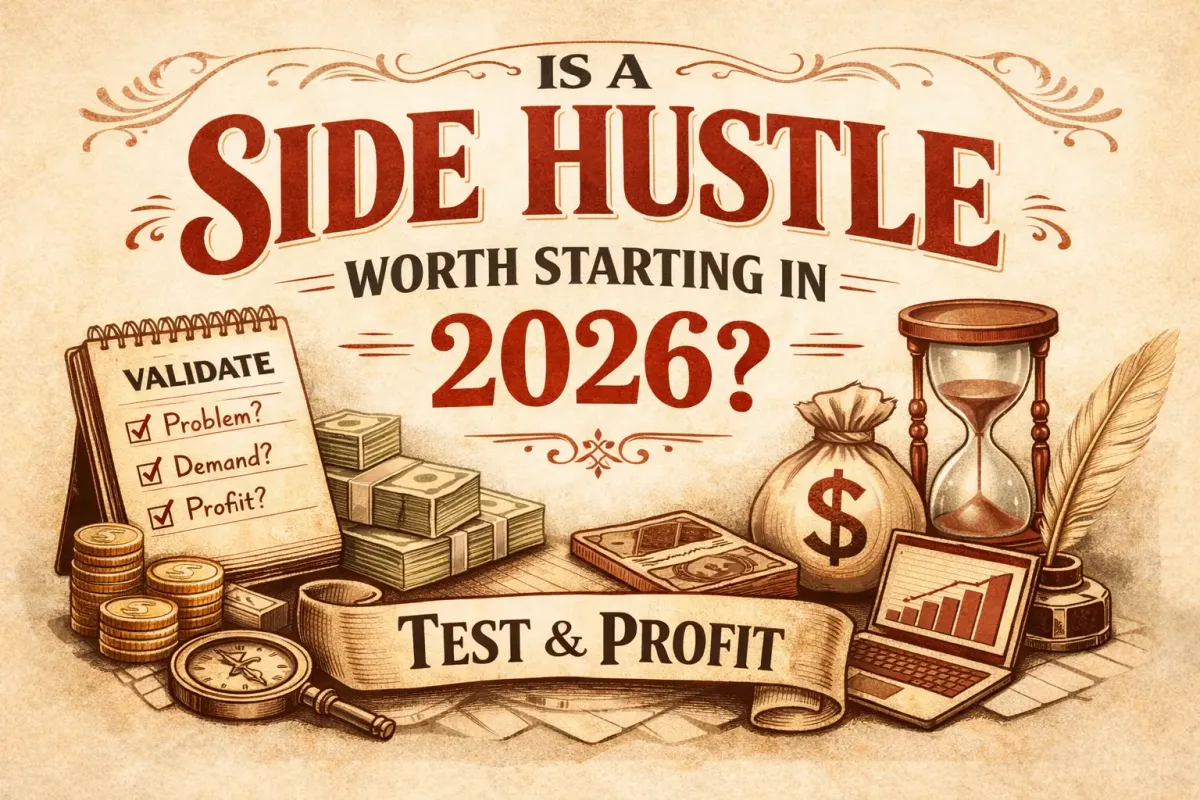
Starting a side hustle in 2026 can be one of the highest-upside moves a new entrepreneur makes—if the idea is tested properly and the work fits real life. The internet has never offered more tools to launch quickly, reach customers faster, and learn what actually sells without spending months building the wrong thing.
At the same time, the same low barriers that create opportunity also create noise: countless “easy money” promises, trend-chasing business models, and side hustle ideas that look exciting but collapse under basic math.
This guide answers one core question: is a side hustle worth starting? It does so with a practical framework that helps a beginner validate a side hustle, run a side hustle test before wasting time, and choose from the best online side hustles of 2026 with a clearer view of demand, profitability, and fit.
Why Starting a Side Hustle Could Be the Best Move of 2026
A side hustle is no longer just a way to earn extra cash. For many beginners, it is:
- A “skills accelerator” that builds capability faster than passive learning
- A risk-managed way to experiment with entrepreneurship without quitting a job
- A second income stream that reduces pressure from rising costs and uncertainty
- A pathway to flexible work, independence, and optionality over time
The 2026 advantage: faster testing, cheaper building, wider distribution
Compared to even a few years ago, 2026 makes side hustles easier to validate because:
- Distribution options are everywhere: short-form video, long-form content, newsletters, marketplaces, communities, and search engines can all drive demand.
- Creation costs are lower: templates, no-code tools, and AI-assisted workflows reduce the time between idea and test.
- Customer feedback is faster: potential buyers can be reached directly through communities and social platforms, allowing quick iterations.
- Micro-niches are viable: smaller audiences can still support profitable offers if the problem is urgent and the pricing matches the value.
What “worth starting” really means (beyond hype)
A side hustle is “worth starting” when it meets three criteria:
- It can reach profitability (not just revenue) within a reasonable time window.
- It fits the person’s life (time, energy, risk tolerance, responsibilities).
- It can repeat and compound (systems, reusable assets, or scalable delivery).
A side hustle is not worth starting when it requires constant motivation to survive, relies on luck to create demand, or fails basic profit and time-fit checks.
Is a Side Hustle Worth Starting? Start With This 10-Minute Filter
Before research spirals into a hundred tabs and a month of planning, a beginner can run a fast triage. This filter catches most weak ideas early.
The 4 non-negotiables (quick score 1–5)
A new entrepreneur can score each item from 1 (weak) to 5 (strong):
- Real problem or desire: Is there a clear pain, frustration, or strong want?
- Clear buyer: Is the customer obvious and reachable?
- Willingness to pay: Do people already spend money to solve this?
- Distribution path: Is there a realistic way to reach buyers consistently?
Interpretation:
- 16–20: strong candidate for a deeper side hustle test
- 12–15: possible, but needs sharper positioning or a better channel
- <12: likely a hobby idea unless a major angle changes
The “energy tax” check
Some side hustles look profitable on paper but quietly drain energy through stress, boredom, or constant context switching. A beginner should consider:
- Does the idea require work that is emotionally heavy (complaints, conflict, constant urgency)?
- Does it demand late-night availability or weekend disruption?
- Does it require a long learning curve before the first sale?
- Does it create anxiety due to uncertainty or lack of control?
If the “energy tax” is high, the side hustle must have a clear upside or it will be abandoned.
Red flags that kill side hustles early
Common early warning signs include:
- The idea depends on going viral to work
- There is no clear customer, only “everyone”
- The pricing is vague or the offer is hard to explain
- The work requires perfection before launch
- The business model relies on a platform the creator does not control
- The plan is to build first and “figure out marketing later”
The Side Hustle Test Ladder: Validate Before Building
This is the core framework for anyone asking: is-side-hustle-worth-starting? The ladder reduces risk by forcing proof at each stage.
Step 1 — Validate the problem (not the idea)
Most side hustles fail because they start with a solution and hunt for a problem. A better approach begins with pain, desire, or a repeated frustration.
A problem is strong when it is:
- Frequent (happens often)
- Expensive (costs time, money, or emotional stress)
- Urgent (people want it fixed soon)
- Specific (easy to describe and recognize)
Simple prompts to define the problem:
- “People struggle to ______ because ______.”
- “The cost of not solving it is ______.”
- “They currently use ______, but it fails because ______.”
A beginner can also identify whether the problem is driven by:
- Time pain (too slow, too much effort)
- Money pain (waste, overpaying, poor outcomes)
- Status/desire (confidence, identity, belonging)
- Risk avoidance (compliance, safety, avoiding mistakes)
Step 2 — Validate demand with proof, not opinions
Demand validation means collecting signals that strangers care—not friends being supportive.
High-quality demand signals include:
- People actively searching for solutions
- Competitors earning money in the same space
- Communities discussing the problem repeatedly
- Buyers paying for imperfect solutions already
Practical demand validation methods:
- Search intent scan: Look for repeated queries that suggest urgency (e.g., “best,” “how to,” “near me,” “cheap,” “alternatives,” “templates,” “pricing”).
- Competitor reality check: Identify who already sells solutions. If competitors exist, that can be positive—competition often proves a market.
- Community validation: Forums and niche groups reveal what people complain about, what they recommend, and what they pay for.
A strong validation outcome is not “many people like the idea.” It is evidence that people try to solve it and spend money doing so.
Step 3 — Validate willingness to pay (the shortest path to truth)
Interest is not the same as payment. The fastest way to validate a side hustle is to test whether people will commit money or meaningful action.
Good willingness-to-pay tests:
- Paid pilot: Offer a limited number of spots at a discounted “founding” price.
- Deposit test: Ask for a small deposit to reserve access or a first slot.
- Paid discovery: For service-based hustles, charge for an audit, consult, or plan.
- Pre-order: Sell the end result before building it fully.
Rules that keep tests honest:
- Avoid “Would you buy this?” questions.
- Instead ask for a decision: “Here is the offer. Here is the price. Want one of the first spots?”
Step 4 — Run a smoke test (minimum viable proof)
A smoke test checks if people act when presented with a clear offer. It can be simple:
- A one-page landing page
- A clear headline that states the outcome
- A short description of the offer
- A price range or starting price
- A call-to-action (book a call, join waitlist, request access, pre-order)
What to measure:
- Clicks to the CTA
- Email sign-ups from targeted visitors
- Replies or DMs from qualified prospects
- Calls booked
- Deposits or pre-orders (best signal)
A side hustle is worth starting when smoke tests produce buyer behavior, not just compliments.
Step 5 — Build the MVP only after signals exist
An MVP (minimum viable product) is not “a cheap version.” It is the smallest deliverable that solves the problem enough to get real feedback.
Examples of MVPs:
- A service delivered manually before automation
- A paid template pack before a full course
- A simple newsletter before a full media brand
- A concierge version of software before building features
The goal is speed to learning while protecting time and energy.
The Profit Reality Check (Most Side Hustles Fail Here)
A side hustle can feel exciting and still be financially weak. Profit validation avoids months of work that never pays properly.
The effective hourly rate (what is actually earned)
A simple formula:
Effective hourly rate = (Revenue − direct costs − fees − refunds − taxes estimate) ÷ total hours
This matters because many side hustles accidentally become low-paid jobs. Profitability is not only about top-line revenue—it is about what remains after time and costs.
Hidden costs to include:
- Platform fees and transaction fees
- Refunds, chargebacks, returns
- Tools and subscriptions
- Ads or promotion
- Packaging, shipping, materials (if relevant)
- Travel and scheduling overhead (for local/offline work)
Break-even: when it stops being a hobby
Break-even answers: “How many sales or clients are needed per month to cover costs and justify effort?”
A beginner can estimate:
- Monthly fixed costs (software, tools, subscriptions)
- Variable costs per sale (fees, delivery costs, time)
- Desired profit target
Then calculate a realistic monthly volume.
If break-even requires an unrealistic number of sales, the offer needs to change: pricing, niche, delivery method, or distribution channel.
Simple unit economics (beginner version)
A side hustle has three moving parts:
- Acquisition: How customers are reached (content, outreach, ads, referrals).
- Conversion: How many become buyers once they see the offer.
- Delivery: How efficiently the result is produced.
The most common “unit economics failure” is delivery: the creator sells something that takes too long to fulfill, causing burnout and low margins.
A strong side hustle usually has:
- Repeatable acquisition (one channel done consistently)
- Clear conversion steps (offer clarity, proof, CTA)
- Efficient delivery (systems, templates, scope control)
Validate Time Fit (A “Good” Hustle Can Still Be Wrong)
Even profitable side hustles can fail if the schedule and energy requirements do not match real life.
The schedule test (weekday vs weekend reality)
A person can ask:
- Can this be done in 5–10 hours per week?
- Does it require fixed hours or can it be done asynchronously?
- Does it demand rapid response times?
- Does it conflict with family, health, or recovery time?
Time-fit is often the deciding factor between a side hustle that lasts and one that fades after two weeks.
The consistency test (can it survive a bad month?)
Side hustles become “worth starting” when they can survive imperfect conditions:
- Low motivation weeks
- Busy seasons at work
- Family disruptions
- A slower month of sales
A hustle that collapses without constant intensity is fragile.
The compounding test (does work create assets?)
Compounding means the work builds something that continues to produce value:
- Content that ranks and brings leads
- A growing email list
- Templates and systems that speed delivery
- Reviews, reputation, referrals
- A product library that sells repeatedly
Compounding is a major reason online side hustles remain attractive in 2026.
Choose a Monetization Path That Matches the Idea
A beginner can dramatically increase success by choosing the simplest monetization model for the problem.
Services vs products vs content (and why it matters)
Services (fast cash):
- Best for beginners with any usable skill
- Easier to validate quickly
- Often limited by time unless productized
Products (scale potential):
- Digital products can scale without physical overhead
- Requires stronger distribution and positioning
- Best after some customer discovery
Content/media (compounding):
- Slowest to start, strongest long-term upside
- Works best with clear niche and consistent publishing
- Monetization through ads, affiliates, sponsorships, products, or memberships
Platform-dependent vs owned-channel
A side hustle can be built on:
- Platforms: marketplaces, social media, gig sites
- Owned channels: website, email list, community
Platforms can accelerate early results, but owned channels protect against algorithm changes and policy shifts. The healthiest model uses platforms for reach while building an owned list for stability.
The “one offer first” rule
Many beginners fail by trying to launch:
- three services
- two products
- a YouTube channel
- a newsletter
- and a course
A more reliable approach is:
- one buyer
- one problem
- one offer
- one channel
Then iterate.
2026 Idea Bank: Best Online Side Hustles to Run Through This Test
This section is not a guarantee of success. It is a shortlist of online side hustle ideas that tend to be viable in 2026 when validated properly.
Each idea includes: what it is, why it can work, and the fastest validation test.
1) AI-assisted freelancing (operator-style services)
What it is: delivering outcomes faster using modern tools (writing, design, research, automations, editing).
Why it can work: businesses pay for speed and reliability, not tools.
Fast validation: offer a “done in 72 hours” package with a clear deliverable and fixed price.
Common trap: selling “AI services” instead of selling a business outcome.
2) Affiliate marketing (niche-first, intent-driven)
What it is: earning commissions by recommending products/services through content, comparisons, or email.
Why it can work: high-intent search traffic and niche trust can convert well.
Fast validation: publish 3–5 “intent pages” (best/alternatives/reviews) and track clicks and email sign-ups.
Common trap: choosing a niche with no buyer intent or weak commissions.
3) Digital products (templates, toolkits, mini-courses)
What it is: selling packaged knowledge or assets.
Why it can work: delivery scales without extra hours per sale.
Fast validation: pre-sell a “founding price” template pack to a small targeted audience.
Common trap: building a large course before proving demand.
4) UGC creator for brands (no large audience required)
What it is: creating short-form content brands use in ads and social.
Why it can work: brands need content volume; creators can monetize skill, not followers.
Fast validation: pitch 20 brands with a portfolio of 5 sample videos and a simple rate card.
Common trap: waiting to “grow an audience” before selling.
5) Micro-niche newsletter + sponsorships
What it is: curating insights and opportunities for a specific niche.
Why it can work: niches pay for relevance; sponsors value targeted attention.
Fast validation: run a landing page with a promise and publish 4 issues in 30 days.
Common trap: choosing too broad a niche, becoming generic.
6) Print-on-demand (niche-first, evergreen angles)
What it is: selling apparel or merch without holding inventory.
Why it can work: micro-niches can sustain steady sales with the right positioning.
Fast validation: test 10 designs and run small targeted promos; focus on conversion data.
Common trap: chasing trends and competing on generic designs.
7) No-code micro tools / lightweight SaaS
What it is: small utilities that solve one recurring pain.
Why it can work: recurring subscriptions can compound.
Fast validation: sell a “concierge” manual version first, then automate the workflow.
Common trap: building features before proving buyers.
8) Coaching/tutoring (skill → packaged offer)
What it is: teaching a skill or helping someone achieve an outcome.
Why it can work: high-margin, fast feedback, strong referrals.
Fast validation: offer a paid 45-minute audit or first-session package.
Common trap: vague positioning (“life coaching”) instead of outcome-specific coaching.
9) Reselling with a system (local → online arbitrage)
What it is: buying undervalued items and reselling at a profit.
Why it can work: simple model with fast cash flow.
Fast validation: source 10 items and track profit per hour and time-to-sell.
Common trap: hoarding inventory without sales discipline.
10) Virtual assistant / “operator” retainers
What it is: recurring support for busy founders (admin, scheduling, inbox, ops).
Why it can work: retainers create stable income.
Fast validation: pitch a narrow package (e.g., “inbox + calendar reset weekly”) to a specific niche.
Common trap: offering everything to everyone, causing scope creep.
A Simple Side Hustle Scorecard (Decision Framework)
A scorecard turns emotion into clarity. The goal is not perfection; it is a rational go/pivot/park decision.
Score each category 1–10
| Category | Score (1–10) | Notes |
|---|---|---|
| Demand evidence | Search intent + competition signals | |
| Willingness to pay | Deposits, pre-orders, paid pilots | |
| Distribution access | Realistic channel the creator will use | |
| Profit potential | Margins + effective hourly rate | |
| Time fit | Schedule compatibility + energy tax | |
| Moat/edge | Unique angle, experience, access | |
| Risk level | Financial, legal, platform, reputational | |
| Delivery simplicity | Can it be delivered reliably? |
Suggested interpretation:
- 70–80+: the side hustle is worth starting (proceed with a 30-day plan)
- 55–69: worth testing, but needs a clearer niche or offer
- <55: pause, change angle, or choose a different idea
30-Day Validation Plan (Idea → First Sale)
This plan is designed for beginners who want clarity fast.
Week 1 — Define the offer and the buyer
- Choose one side hustle idea to test
- Write a one-sentence offer:
- “This side hustle helps [who] get [result] without [pain] in [timeframe].”
- Draft a simple pricing hypothesis (even a range)
- List 20 places the buyer can be reached (groups, forums, niche communities, platforms)
Outcome: a clear offer with a reachable audience.
Week 2 — Research and customer discovery
- Identify 5–10 competitors (or substitutes)
- Collect common phrases customers use (their language becomes marketing copy)
- Have 10 short conversations (or message exchanges) with target buyers:
- What are they trying to achieve?
- What have they tried?
- What would make them pay?
- What would stop them?
Outcome: sharper positioning and realistic pricing.
Week 3 — Smoke test and outreach
- Build a one-page landing page (or a simple doc page)
- Write 2–3 outreach messages and send to 30 targets
- Publish 2 pieces of content aimed at the problem (if content-driven)
- Track:
- replies
- sign-ups
- calls booked
- deposits
Outcome: real market response.
Week 4 — Paid pilot and tightening delivery
- Offer a limited paid pilot:
- “5 founding spots”
- “50% off for testimonials”
- “delivered in 7 days”
- Deliver the work manually but document the steps
- Collect testimonials and refine the offer
- Decide:
- double down
- pivot niche/offer
- park the idea
Outcome: first paying customers and a repeatable process.
Mistakes to Avoid When Testing Side Hustles in 2026
Side hustles usually fail from predictable mistakes. Avoiding them can be a competitive advantage.
Building too much before testing
Many beginners spend weeks:
- designing a brand
- perfecting a website
- creating a full product
- polishing a logo
None of that proves demand. Validation comes from real buyer behavior.
Asking friends instead of buyers
Friends often encourage without buying. The market is the only honest judge.
Underpricing to “get experience”
Underpricing causes:
- low margins
- burnout
- low-quality clients
- weak confidence in the offer
A better approach is a small “founding price” for a limited group, then raise pricing as proof builds.
Platform addiction (no owned channel)
Relying entirely on one platform introduces risk. A simple email list creates stability and compounding value.
Changing too many variables at once
If a side hustle test changes:
- niche
- offer
- pricing
- channel
- messaging
…all in one week, it becomes impossible to learn what worked. Controlled testing is faster long-term.
Ignoring delivery constraints
If delivery takes too long, the hustle becomes a trap. Productizing, templating, and tightening scope are essential.
FAQs: Is a Side Hustle Worth Starting?
Is a side hustle worth starting if it only makes a little money at first?
It can be worth starting if early income is part of a bigger trajectory. Many strong side hustles begin small but improve through better positioning, pricing, and distribution. The key is whether the work builds proof, skills, and assets that can compound.
How does someone know if a side hustle is profitable?
Profitability is best measured with an effective hourly rate and basic unit economics. If a side hustle produces consistent profit after costs and does not require unsustainable hours, it is trending toward “worth it.” If revenue is rising but free time is disappearing, profitability may be an illusion.
How long should a person test a side hustle before quitting?
A reasonable test window is 30–60 days for early validation. If there is no demand signal after consistent testing—no qualified leads, no sign-ups, no calls, no deposits—then the idea likely needs a major pivot. Quitting early is not failure; it is efficient learning.
Should a beginner start with an online or offline side hustle?
Online side hustles often offer better compounding and scalability, while offline side hustles can generate faster local cash flow. The best choice depends on time fit, skills, and access to customers. A beginner can also use an offline service to generate cash while building an online asset in parallel.
Do side hustles still work in 2026, or is everything too competitive?
Side hustles still work in 2026 because demand is endless for real outcomes. Competition is often proof that money exists in the market. The difference is that generic offers struggle, while focused niche offers with clear positioning can win.
What is the best way to validate a side hustle idea?
The best approach is a ladder:
- validate the problem,
- validate demand,
- validate willingness to pay,
- run a smoke test,
- build only after signals exist.
Validation is about proof from strangers, not encouragement from friends.
Is affiliate marketing still worth starting in 2026?
It can be worth starting if the niche has buyer intent, the content strategy targets decision-ready searches, and the creator builds an owned audience (email). It is not worth starting if the plan depends on “easy passive income” without consistent publishing and trust-building.
How much should a side hustle make to be considered “worth it”?
There is no universal number. For some, it is $200–$500 per month to reduce stress. For others, it is replacing a salary. A practical benchmark is whether it pays enough to justify time and energy and shows signs of growth or compounding.
What if a person has too many side hustle ideas?
The solution is to choose one idea and run a structured side hustle test. The market will provide feedback quickly. Most people do not need more ideas—they need one tested idea.
Final Decision: Is a Side Hustle Worth Starting in 2026?
A side hustle is worth starting in 2026 when it is treated like a testable business, not a fantasy. The strongest signal is not motivation; it is market proof.
If demand is visible, willingness to pay is real, the math works, and the hustle fits life, then the answer to is a side hustle worth starting becomes clear: yes—start small, test fast, and build only what the market proves.
The biggest upside of 2026 is that beginners can move from idea to proof quickly. The side hustlers who win are not the ones with the most side hustle ideas. They are the ones who validate one idea, execute consistently, and let compounding do the heavy lifting.