How to Get Your First Paying Customer (Even Starting From Zero)
A step-by-step guide to landing your first paying customer—what to offer, where to find leads, copy/paste scripts to reach out, and a simple close that doesn’t feel salesy. Includes a 7-day challenge to earn your first side hustle income.
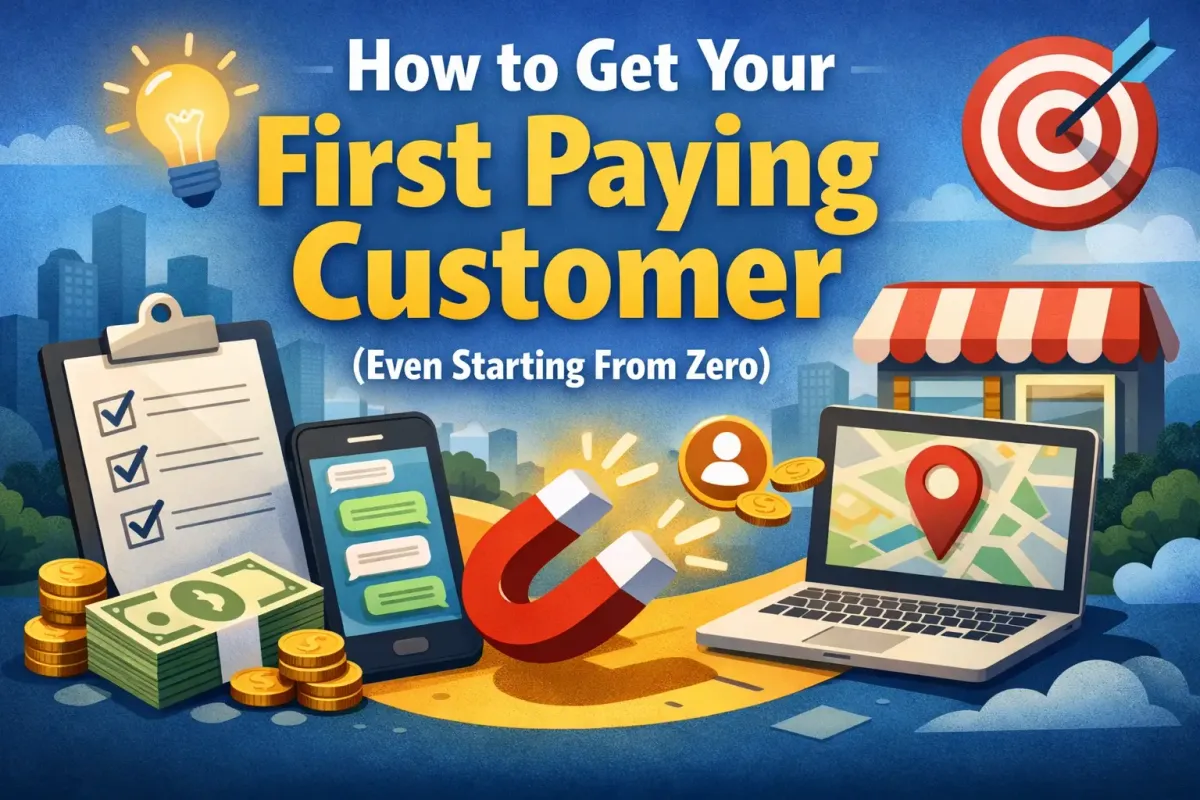
Getting the first paying customer is the biggest milestone in a side hustle. Not because the money is life-changing on day one—but because it proves something important:
- someone will pay for the offer
- the idea works in the real world
- the side hustle can turn into consistent side income
Most beginners stall right before this moment. They research, plan, watch videos, read threads, and “get ready”… but never ask anyone to buy.
This guide is designed to remove that friction. It lays out exactly what to offer, where to find leads, what to say, and how to close—without feeling pushy or salesy. It also includes a simple 7-day challenge to land the first side hustle customer quickly.
Start With the Right Offer (So People Say “Yes”)
A beginner’s first mistake is trying to sell everything to everyone. A clear offer closes faster than a “general services” pitch.
Use the one-sentence offer formula
A beginner should be able to say the offer in one sentence:
“I help [who] get [result] without [pain].”
This forces clarity, and clarity creates trust.
Examples (online + offline)
- “I help busy families get a clean home without spending their weekends cleaning.”
- “I help homeowners get their yard cleaned up without hiring a big landscaping company.”
- “I help local businesses post consistently on social media without needing a full-time marketer.”
- “I help students improve grades in math without cramming the night before tests.”
- “I help sellers turn clutter into cash without wasting hours on back-and-forth messages.”
- “I help small businesses refresh old website pages without rebuilding their whole site.”
- “I help professionals polish resumes and cover letters without rewriting from scratch.”
- “I help pet owners keep dogs walked and cared for without rearranging their schedule.”
A beginner doesn’t need a clever brand name. They need a clear result.
Don’t sell tasks—sell outcomes
Beginners often describe tasks because tasks are easy to explain:
- “I do cleaning.”
- “I do VA work.”
- “I do editing.”
But people don’t buy tasks. They buy outcomes:
- a clean kitchen and bathroom
- a yard that looks “done”
- an inbox that stops overflowing
- a post schedule that keeps business visible
- a document that looks professional
Outcome language makes the offer feel valuable even when the beginner is new.
Quick exercise: turn tasks into outcomes
- Task: “social media posting” → Outcome: “consistent weekly posts so customers remember the business exists”
- Task: “proofreading” → Outcome: “clean, professional writing that doesn’t cost credibility”
- Task: “yard cleanup” → Outcome: “a neat yard that stops feeling embarrassing”
Beginner-friendly pricing (simple, confident, not too cheap)
Pricing is where many beginners freeze. They either:
- underprice so low that it feels untrustworthy, or
- overthink pricing for weeks and never launch
A better approach is to use starter pricing with a clear minimum.
Three pricing rules that help beginners
- Set a minimum job size
Even if someone is “just starting,” tiny jobs often create big headaches. A minimum protects time. - Price the outcome, not the effort
If the result is valuable, the price should reflect the value. Effort matters, but customers buy results. - Use simple packages when possible
Packages reduce awkward “hourly debates” and make it easier for a beginner to sell confidently.
Starter pricing models (choose one)
- Flat package price (best for services with clear scope)
Example: “Standard Clean $X” / “Deep Clean $Y” - Starting from price (best when scope varies)
Example: “Yard cleanup starting from $X (final quote after photos)” - Hourly with minimum (good for early stage)
Example: “$X/hour, 2-hour minimum”
Avoid “too cheap to trust”
Being “the cheapest option” often attracts:
- customers who don’t respect boundaries
- last-minute cancellations
- endless negotiation
A beginner doesn’t need to be expensive. They need to be reasonable and confident.
Where to Find Your First Paying Customer (Fastest Lead Sources)
The fastest path to a first paid side hustle is usually:
- warm leads (people who already trust you), then
- local/community leads, then
- cold outreach (for scale)
This section breaks down offline and online lead sources and explains how to use each without spamming.
Fast Offline Lead Sources (Local Wins)
Offline side hustles often win on speed because local demand already exists.
1) Warm network (the right way to ask)
Warm leads are the fastest because trust is already there. But beginners often ask in a way that feels awkward:
- “Do you want to buy from me?” (too direct, too vague)
A better approach is to ask for referrals and keep it specific.
Warm referral script (text/DM)
“Quick question—do you know anyone who might need help with [specific outcome] this week? I’m taking on a couple of small jobs to build up my side hustle. Happy to send details.”
If someone replies “maybe,” follow with:
“No stress—if you think of one person, feel free to connect us. I’ll keep it simple and professional.”
The goal isn’t to pressure friends. It’s to borrow trust to get the first job.
2) Local community groups (post the right way)
Local groups can work, but beginners often fail by posting like a spam ad.
A good post includes:
- who it’s for
- what’s included
- where it’s available
- a starting price range
- how to book
- proof if possible (even one testimonial helps)
Example community post (local service)
“Hi neighbors—offering basic home cleaning in [area] on weekends.
Includes: kitchen + bathroom + floors + tidy/reset.
Starting from: $X (depends on home size).
If you’d like a slot, message me with your suburb and a quick description.”
3) Noticeboards, flyers, and “offline placements”
Old-school can still work when targeted:
- local cafes
- gyms
- community centers
- laundromats
- vet/pet stores (for pet services)
A flyer doesn’t need to be fancy. It needs:
- one clear offer
- one way to contact
- one reason to trust (even “local + reliable”)
4) Respectful door-to-door (optional, for the right hustles)
Not everyone wants to do this, but it can work for:
- yard cleanup
- pressure washing
- dog walking
- car washing
Safety first:
- daytime only
- keep distance
- never push
- one neighborhood, short timeframe
Door-to-door opener (friendly + low pressure)
“Hi—sorry to interrupt. I’m local and offering [service] this week. If you ever need help with [outcome], I can leave a card. No pressure at all.”
The goal is to plant a seed, not force a sale.
5) Local partnerships (quiet but powerful)
Partnerships create leads without constant outreach. Examples:
- cleaners partnering with real estate agents
- lawn services partnering with property managers
- pet sitters partnering with groomers
- car detailers partnering with mechanics
A beginner doesn’t need formal agreements. They can start with:
- a simple introduction
- a referral bonus
- a professional approach
Fast Online Lead Sources (Remote Wins)
Online doesn’t mean “easy,” but it can be fast if a beginner keeps the offer clear and outreach consistent.
1) Marketplace listings (services and reselling)
Platforms where people already search can produce fast results:
- local marketplace listings for services
- gigs for online services
- reselling platforms for flipping
The key is speed:
- clear title
- good photos
- fast replies
- simple pricing
2) Gig platforms (use them as training wheels)
Gig platforms can help beginners:
- get proof
- learn customer expectations
- collect reviews
But they also have risks:
- race-to-the-bottom pricing
- platform dependency
A good strategy:
- use platforms to get the first 2–3 clients
- then shift toward direct leads with testimonials
3) LinkedIn outreach (simple beginner method)
LinkedIn works when the message is helpful and specific.
Beginner rule:
- don’t pitch everyone
- pitch a specific type of business with a specific problem
Examples:
- “local accountant” → needs consistent posts and a clean website
- “tradie” → needs updated services pages and reviews
- “ecommerce brand” → needs product descriptions and email flows
4) The “spot the problem” approach (high conversion)
This works well for online services like:
- website fixes
- copywriting edits
- social media support
- review cleanup
- local SEO basics
Step-by-step:
- Find a business with an obvious issue (broken link, outdated page, messy bio)
- Send a message pointing it out kindly
- Offer a simple fix package
This approach works because it’s real. It shows competence without bragging.
5) Communities (Reddit/Discord) without spamming
A beginner can get leads by being useful:
- answer questions
- share mini guides
- offer to help privately
The rule is simple:
- provide value first
- don’t post “DM me” everywhere
- build trust through helpful responses
Warm vs Cold Leads: The fastest strategy
Beginners should start with warm leads because they close faster.
A simple plan:
- Day 1–3: warm outreach + community posts
- Day 4–7: cold outreach for scale
Warm leads create momentum. Cold outreach builds the engine.
What to Say (Scripts That Don’t Feel Salesy)
Most people don’t hate selling. They hate feeling like they’re pressuring someone.
The solution is to use scripts that are:
- short
- helpful
- clear
- low-pressure
The #1 rule: lead with help, not hype
Bad outreach sounds like:
- “This is an amazing opportunity!”
- “Guaranteed results!”
- “Limited spots!”
Good outreach sounds like:
- “Quick question…”
- “I noticed…”
- “Would it help if…”
- “If not, no worries.”
Copy/Paste Script Bank (Warm, Cold, Follow-Up, Posts)
Warm outreach scripts (text/DM)
Warm script 1 (friendly)
“Hey! Quick one—do you know anyone who might need help with [outcome] this week? I’m building my side hustle and taking 2–3 jobs. Happy to send details.”
Warm script 2 (direct)
“If you or someone you know needs [service] in the next week or two, I’ve got a couple of openings. Want me to send the details?”
Warm script 3 (professional)
“Hi—starting a small side service for [who]: [offer sentence]. If you know someone who could use it, I’d appreciate an intro.”
Follow-up scripts (the money is in follow-up)
Follow-up 1 (24–48 hours)
“Just following up—no rush. If you’d like the details or want to ask anything, happy to help.”
Follow-up 2 (final)
“Last note from me—totally fine if timing isn’t right. If you ever need help with [outcome], feel free to message anytime.”
Cold outreach scripts (DM/email)
Cold outreach works when it feels personal and specific.
Cold script 1 (problem/solution)
“Hi [Name]—noticed your [website/social page] and saw [specific issue]. If it helps, I can fix that this week with a quick [package]. Want me to send a price and what’s included?”
Cold script 2 (offer + quick CTA)
“Hi [Name]—I help [who] get [result] without [pain]. If you’re looking to improve [specific result], I can do a starter package this week. Interested?”
Cold script 3 (local service outreach)
“Hi! I’m local to [area] and offering [service] on weekends—especially for [who]. If you’d like a quote, reply with your suburb and what you need help with.”
Community post template (copy/paste)
Offering: [service] for [who]
Includes: [3–5 bullet points]
Availability: [days/times]
Starting from: $X (depends on [factor])
How to book: message me with [details needed]
“No experience” credibility line (use carefully)
Beginners often worry they can’t sell without experience. They can be honest without underselling:
“This is a new side hustle, so pricing is starter-level. The work is professional, reliable, and communication is clear. Happy to answer questions and confirm what’s included upfront.”
How to Close Your First Customer (Without Being Pushy)
Closing is easier than most beginners think. It’s just a clear next step.
The 3-step close
Step 1: Confirm the problem
- “So you’re looking for X by Y date, correct?”
Step 2: Confirm the offer + price
- “For that, the package is $X and includes A, B, C.”
Step 3: Confirm the next step
- “Would you like to book for [day/time]? If yes, I’ll send the details.”
This is not pushy. It’s professional.
Handling the most common objections
“It’s too expensive”
A beginner shouldn’t panic-discount. They should clarify value and offer choices.
“Totally fair. If budget is the main concern, I can offer a smaller package at $X that covers the essentials. Want the details?”
“I need to think about it”
This usually means uncertainty, not rejection.
“No worries. What would help you decide—timing, price, or what’s included?”
“Can you do it cheaper?”
Use boundaries.
“I can’t do the full scope for less, but I can reduce the scope to fit your budget. Want a smaller option?”
“Do you have experience?”
Use proof and professionalism:
- show a checklist
- show a simple process
- offer references if available
“This is a new side hustle, but the process is solid and the work is professional. I’ll confirm what’s included upfront and keep communication clear.”
Risk-reversal that works for beginners (without dangerous guarantees)
Avoid open-ended guarantees (“If you’re not happy, it’s free”). That invites abuse.
Use controlled risk-reversal:
- small re-do within 24 hours
- clear scope agreement
- deposits for booked times
Example:
“If something we agreed on is missed, it’ll be fixed within 24 hours—no stress.”
Deliver Like a Pro (So the First Customer Becomes 3)
The first customer isn’t just money. It’s the start of a referral chain.
The “first job” playbook
- Confirm scope before starting
- Communicate clearly
- Show up on time
- Take before/after proof (where appropriate)
- Finish with a simple “walkthrough” or summary
A beginner should aim to be:
- reliable
- clear
- easy to work with
That alone makes them better than many competitors.
Get a testimonial the right way
Ask at the right moment—right after the customer is happy.
Review request script
“Thanks again—glad that helped. Would you be open to a quick 1–2 sentence review? It really helps a new side hustle get going.”
Make it easy:
- provide a link if applicable
- or ask for a text message testimonial
Turn one customer into referrals
Referrals feel awkward when asked the wrong way. Ask it simply:
Referral ask script
“If you know one person who might need this, I’d really appreciate an intro. No pressure—just if someone comes to mind.”
Or:
“Who’s one friend who complains about [problem] the most?”
The 7-Day First Customer Challenge (Step-by-Step)
This is the “do the work” plan that produces first side gig income.
Day 1: Pick one offer + one customer type
- one outcome
- one lane
- one sentence offer
Day 2: Set pricing + boundaries
- minimum job size
- package or hourly + minimum
- service area/availability
Day 3: Warm outreach (20 messages)
- send 20 warm DMs/texts
- ask for referrals
- keep it short
Day 4: Post in 1–2 channels + follow-up
- local group or marketplace
- follow up with responders
Day 5: Cold outreach (20 messages)
- targeted businesses or potential clients
- problem/solution message
Day 6: Book + deliver
- confirm scope
- deliver well
- request review
Day 7: Testimonial + referral + repeat
- collect review
- ask for 1 referral
- post again using proof
If a beginner completes this challenge fully, it’s uncommon to still be at $0. The process forces real-world action.
Common Mistakes That Delay First Side Gig Income
1) Waiting for a website or logo
A beginner can sell with:
- one offer message
- one pricing range
- one way to book
A website can come later.
2) Offering 10 services instead of one
More options creates more confusion. One clear offer sells faster.
3) Not following up
Most sales happen after follow-up. Beginners quit too early.
4) Underpricing and attracting nightmare customers
Too cheap invites:
- endless negotiation
- disrespect
- unreliable clients
Reasonable pricing plus boundaries is safer.
5) Posting in places with no buyers
If a platform doesn’t have buyers actively searching, it won’t convert. Choose channels where people already buy.
FAQs: Getting Your First Paying Customer
How do beginners get their first customer?
Beginners get the first customer by choosing one clear offer, doing warm outreach first, posting in one or two places where buyers exist, following up, and delivering quickly. Consistency matters more than perfection.
How do you get your first paying client with no experience?
The fastest approach is to start with a simple, outcome-based offer and use starter pricing while focusing on reliability and communication. Proof builds quickly after the first job, especially when testimonials are collected.
How do you get customers for a side hustle fast?
Warm referrals, local community groups, marketplace listings, and direct outreach tend to produce the fastest results. A 7-day outreach sprint can create momentum quickly.
What should you say to get your first customer?
A beginner should keep it short and helpful: who it’s for, the outcome, the starting price, and the next step to book. Avoid hype and focus on clarity.
How do you price your first side hustle service?
Starter pricing works best: set a reasonable rate, set a minimum job size, and adjust after 3–5 real jobs. Packages simplify pricing and close faster than hourly debates.
How many messages should you send to get a client?
It varies, but many beginners can land a first client within 20–60 targeted messages when the offer is clear and follow-up is consistent.
Where can you advertise your side hustle for free?
Local community groups (where allowed), marketplaces, neighborhood boards, social profiles, and direct outreach are common free channels. Warm referrals often work best early on.
Should you work for free to get your first customer?
Working free is usually unnecessary. A better option is starter pricing, small scope jobs, or a limited “first 3 customers” discount. If a free job is done, it should be controlled and used to produce proof.
How do you close a client without being salesy?
Confirm the problem, confirm the offer and price, then offer a clear next step. A professional close is not pushy—it’s clear.
How do you handle “too expensive” objections?
Offer a smaller scope option rather than discounting the full job. Keep boundaries and emphasize the outcome.
Conclusion: The First Paying Customer Changes Everything
The first paying customer isn’t just income. It’s proof.
Once proof exists, everything gets easier:
- confidence improves
- outreach becomes simpler
- pricing becomes clearer
- referrals start to appear
The process is straightforward:
- pick a clear offer
- find leads (warm first, then cold)
- use simple scripts
- close with a clear next step
- deliver well
- collect proof and referrals
If a beginner follows the 7-day challenge and keeps it consistent, the first customer is not a question of “if.” It becomes a question of “when.”
Subscribe to Hustler Herald for weekly playbooks that turn side hustle ideas into first income—step by step.