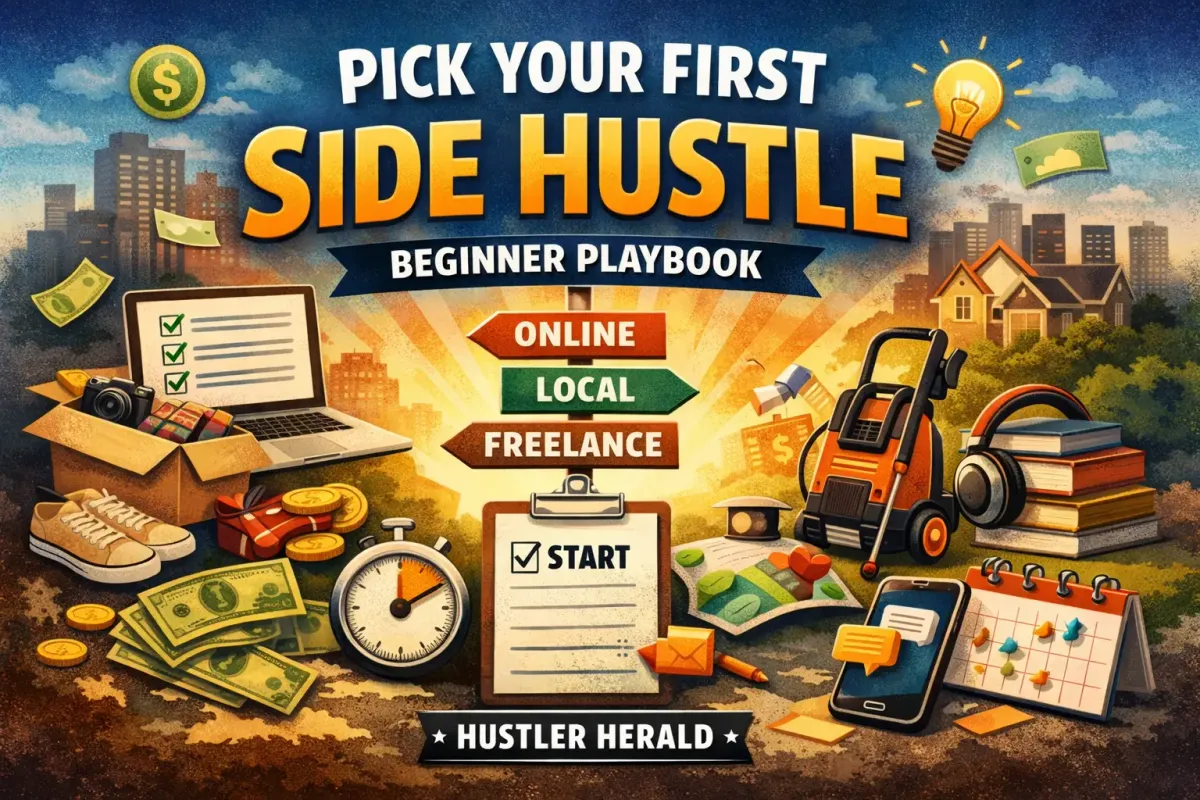
Start Here: Pick Your First Side Hustle (Beginner Playbook)
Pick the right first side hustle with a simple scorecard, quick validation tests, and a 7–14 day launch sprint. Learn how to start earning secondary income online or offline without getting overwhelmed.
Starting a side hustle can be one of the fastest ways to build secondary income, learn valuable skills, and create more control over financial life. But the first decision—which side hustle to start—often determines whether someone gains momentum or burns out and quits.
This playbook is designed for side hustles for beginners, as well as people who have tried a few things and want a smarter approach. It focuses on choosing a first side hustle that fits real-life constraints: time, energy, budget, and confidence. It also includes a practical scoring system and a simple 7–14 day launch sprint to help readers move from “thinking about it” to earning the first dollar.
What a “First Side Hustle” Should Do (and What It Shouldn’t)
A first side hustle has one job: build momentum.
That means it should make it easier to:
- take consistent action
- get a quick win (first lead, first sale, first paying customer)
- learn how money is actually made outside a paycheck
- improve week by week without becoming complicated
A good first side hustle prioritizes momentum
For most beginners, the biggest risks aren’t competition or lack of talent. The biggest risks are:
- overthinking
- choosing something too complex
- chasing perfection (branding, websites, courses) before any customer exists
- taking on a hustle that clashes with schedule and energy
A good first side hustle is usually:
- simple to explain
- easy to start with minimal tools
- clear about who the customer is
- easy to deliver repeatedly
- able to produce income quickly enough to stay motivating
A first side hustle is not always the “best side hustle”
People often search for the best side hustle like there’s one universal answer. But “best” changes based on the person.
The best first side hustle for one person might be terrible for someone else. For example:
- A social person may thrive in a referral-based local service.
- An introvert may prefer an online, asynchronous service or reselling.
- Someone with limited time may need a hustle that works in short bursts.
- Someone with high urgency may need fast cash, not long-term “build a brand” strategies.
The best side hustle is the one that:
- fits current life
- can be started within 7–14 days
- generates proof of demand quickly
- can be improved without turning into chaos
Step 1 — Set the Target: What Is the Secondary Income For?
Before choosing a hustle, it helps to define why the hustle exists.
Pick one primary goal
Most side hustles fail because the goal is vague (“make extra money”). A strong goal makes decisions easier.
Here are common goals that shape the best first side hustle:
1) Build breathing room
- Cover groceries, fuel, utilities, or a small buffer
- Best fit: fast-to-cash hustles with clear demand (local services, gigs, reselling)
2) Pay off debt
- Needs consistent cash flow
- Best fit: repeatable services with recurring customers or weekly demand
3) Create long-term optionality
- Build skills and a portfolio that can later change careers or lead to a business
- Best fit: online services, content, or a niche skill hustle
4) Build a scalable asset
- Something that earns while sleeping (slow at first, bigger later)
- Best fit: content + affiliate, digital products, audiences
5) Test entrepreneurship
- Learn sales, customer service, systems, and execution
- Best fit: any hustle that requires creating an offer and selling it
Choose a realistic timeline
Different timelines produce different hustle choices.
If someone needs money soon, they should prioritize:
- speed to first customer
- existing demand
- low setup time
If someone can wait, they can prioritize:
- higher upside
- scalable assets
- deeper skill-building
A practical way to set a target is to answer these questions:
- How much extra income is needed per month?
- How many hours per week are available?
- How soon does income need to start?
- How much risk can be tolerated?
Even a simple target like “$100/week within 30 days” will sharpen the decision process.
Step 2 — Know the Constraints: The Reality Check
A side hustle succeeds when it fits the person’s life. A hustle fails when it fights the person’s life.
Time & energy audit
Instead of guessing, beginners can do a quick audit:
How many hours per week are truly available?
- 3–5 hours/week (light)
- 6–10 hours/week (moderate)
- 10–15 hours/week (strong momentum)
- 15+ hours/week (serious build mode)
When are those hours available?
- short bursts during weeknights
- longer blocks on weekends
- one evening + one weekend block
What kind of work fits the energy level?
- If evenings are low-energy, deep creative work may be hard.
- If weekends are busy, long client jobs may be difficult.
Is the person better at deep work or small tasks?
- Deep work hustles: content creation, building a website, learning a skill
- Small task hustles: outreach, reselling, short gigs, micro-services
Money & risk tolerance
Not every hustle requires investment, but every hustle has some cost—if not money, then time and energy.
Beginner-friendly choices usually:
- start with $0–$100
- use tools already owned (phone, laptop, basic equipment)
- avoid expensive inventory or long learning curves
A helpful question is:
How much money can someone afford to lose if the hustle doesn’t work?
If the answer is “not much,” avoid:
- large inventory buys
- expensive equipment
- paid ads early
- long training programs before selling anything
Job conflict & practical limits
Some people have employer rules that limit what they can do (especially in certain industries). Others have lifestyle limits:
- no car
- no storage space
- no quiet place to work
- physical limitations
- family commitments
There’s no shame in these constraints. They’re simply the rules of the game.
The best first side hustle is the one that plays within the rules.
Step 3 — Choose Your Hustle Type (Pick the Right Bucket First)
One of the fastest ways to reduce overwhelm is to choose your hustle path “bucket” before choosing the exact hustle.
Most first side hustles fall into five buckets:
- Local services
- Online services
- Reselling & flipping
- Content + affiliate (long-term)
- Gig economy work
Local service hustles (often fastest to first cash)
Local services can be the quickest way to make secondary income because:
- demand exists everywhere
- customers understand the offer
- referrals happen naturally
- payment is immediate or simple
Examples:
- cleaning (homes, offices)
- lawn mowing and garden tidy-ups
- car detailing
- pressure washing
- pet sitting / dog walking
- moving help / junk removal
- handyman help (if skilled and permitted)
Who local services fit best
- people who don’t mind physical work
- those who can do weekends or evenings
- people comfortable talking to customers
- anyone who wants speed and simplicity
Common beginner mistake
Trying to offer too many services at once. Beginners should pick one clear service and make it easy to buy.
Online service hustles (fast + flexible)
Online services can also be fast-to-cash, especially for people who:
- prefer working on a laptop
- want flexible hours
- can work asynchronously
Examples:
- virtual assistant work
- editing and proofreading
- simple graphic design (social posts, flyers)
- short-form video editing
- bookkeeping (for those with skills)
- resume or LinkedIn profile help
- outreach or appointment setting
- customer support
Who online services fit best
- people who want flexibility
- introverts who prefer less face-to-face work
- those with basic computer confidence
- people willing to message prospects consistently
Common beginner mistake
Starting by selling “skills” instead of outcomes. Customers buy outcomes: time saved, posts created, leads booked, videos edited.
Reselling & flipping (fast cash, but requires sourcing)
Reselling can work quickly because the product already exists. The hustle is finding underpriced items and reselling them.
Examples:
- marketplace flipping (furniture, electronics, tools)
- clearance to resale (retail arbitrage)
- used books, collectibles, niche items
- “free pickup” items cleaned and resold
Who reselling fits best
- people who like hunting deals
- those who have space to store items (even small)
- people comfortable with photos and messaging
- anyone who wants quick wins
Common beginner mistake
Buying too much inventory too early. A first reselling hustle should start small and prove the process works.
Content + affiliate (slow burn, scalable)
Content and affiliate marketing are popular because they can become scalable assets. But they’re slower. Beginners should set expectations:
- it can take months to earn meaningful income
- consistency is required
- the early phase feels quiet
Examples:
- niche blog answering specific questions
- a YouTube channel with tutorials
- a newsletter with curated deals or guides
- product reviews and comparisons
Who content fits best
- people who enjoy writing or teaching
- those with patience
- those who can commit to consistent publishing
- people interested in building a long-term asset
Common beginner mistake
Choosing a niche that’s too broad (“making money online”) and producing generic content. Specificity wins.
Gig economy work (easy entry, lower control)
Gig work is easy to start because platforms supply demand, but it often has:
- less control
- variable income
- wear-and-tear costs (vehicle, time)
Examples:
- rideshare
- food delivery
- task platforms
- casual shifts
Who gigs fit best
- someone needing immediate cash flow
- someone not ready to sell or market
- people who want structure
Common beginner mistake
Ignoring real costs (fuel, maintenance, time). If gig work is used, it should be tracked carefully.
Step 4 — Build a 3-Idea Shortlist (Stop Choosing From 100 Options)
Once the hustle bucket is chosen, the next step is to create a shortlist of three ideas.
Three is powerful because:
- it prevents decision paralysis
- it creates comparison
- it leaves room for a “Plan B” if something doesn’t fit
Start with skills, then match to demand
Beginners often ask, “What should I do with no skills?”
Almost everyone has some useful skills:
- reliability and follow-through
- communication
- organization
- basic tech comfort
- ability to learn quickly
- physical capacity for simple tasks
Instead of aiming for the perfect skill match, aim for:
- something the person can do this week
- something people already pay for
Use beginner-friendly filters
A first side hustle should ideally pass these filters:
- Low cost to start ($0–$100)
- Simple delivery (clear steps, repeatable)
- Clear customer (who pays)
- Clear offer (what’s sold)
- Fast feedback (demand shows quickly)
If an idea requires months of learning before the first sale, it might be a great long-term hustle—but it is usually not the best first hustle.
Step 5 — Use the Side Hustle Scorecard (Choose the Best Option for You)
A scoring system turns emotional choices into practical decisions.
Below is a beginner-friendly scorecard. Each idea is scored from 1–5.
The Side Hustle Scorecard (1–5 points each)
1) Speed to first dollar
- 5 = can earn within 7–14 days
- 3 = likely within 30–60 days
- 1 = could take months
2) Startup cost
- 5 = $0–$50
- 3 = $50–$300
- 1 = $300+
3) Demand clarity
- 5 = people already buy this constantly
- 3 = demand exists but unclear niche
- 1 = demand is uncertain
4) Ease of getting customers
- 5 = customers are easy to find locally or online
- 3 = requires moderate outreach
- 1 = requires heavy marketing
5) Fit with schedule
- 5 = can be done in short sessions or flexible blocks
- 3 = requires fixed times sometimes
- 1 = requires long uninterrupted blocks regularly
6) Energy match
- 5 = suits personality and energy type
- 3 = manageable but draining
- 1 = likely to cause burnout
7) Repeatability
- 5 = same process can be repeated weekly
- 3 = some repeatability
- 1 = always custom, hard to systemize
8) Learning curve
- 5 = can start now
- 3 = can learn basics in a week
- 1 = requires deep skill training first
9) Income potential
- 5 = can realistically grow beyond beginner income
- 3 = decent but capped
- 1 = low upside
10) Risk and liability
- 5 = low risk, low liability
- 3 = moderate
- 1 = high risk
Decision rule for beginners
The best first side hustle is usually:
- the highest-scoring option
- that can be launched within 7–14 days
- with the clearest path to a paying customer
That last part matters most. Momentum is worth more than perfection.
Step 6 — Validate Demand Before Committing (Fast, Cheap Tests)
Validation is the step that separates “ideas” from “income.”
A beginner does not need market research reports. They need signals:
- Will people respond?
- Will people ask about price?
- Will people want it soon?
Validation methods that work for beginners
1) Talk to 10 potential customers
This can be:
- messages to friends and acquaintances
- community groups
- local boards
- coworkers (carefully)
- online communities
The goal is not to “pitch.” The goal is to learn:
- What do people already pay for?
- What frustrates them?
- What would they pay to avoid?
2) Make an offer post
For local services:
- post in community groups (where allowed)
- keep it simple: offer, area, price range, availability
For online services:
- post in relevant groups
- ask for referrals
- offer a limited number of spots
3) Create a simple landing page
This can be a single page with:
- what it is
- who it’s for
- what’s included
- starting price
- how to book
4) Pre-sell a small package
This is one of the strongest validation methods. It forces clarity:
- what’s included
- timeframe
- price
Pre-selling doesn’t require a big audience. It requires a clear offer and the willingness to ask.
What to look for (signals)
Strong signals:
- “How much do you charge?”
- “When can you do it?”
- “Do you service my area?”
- “Can I book this week?”
Weak signals:
- likes with no messages
- vague encouragement (“cool idea!”)
- endless questions without commitment
Validation isn’t about getting hundreds of leads. A beginner only needs a handful to get started.
Step 7 — Launch a “First Dollar” Plan (7–14 Day Sprint)
This is the bridge between planning and earning.
A first side hustle should be launched like a sprint:
- small
- focused
- measurable
- designed to produce a first customer
Day 1–2: Define the offer (keep it simple)
A beginner offer should include:
- who it’s for
- what outcome it delivers
- what’s included
- how long it takes
- starting price or price range
- how to book
Examples of beginner-friendly offers:
- “One-time deep clean for small apartments (2–3 hours).”
- “Basic car detail package (interior + exterior).”
- “Short-form video editing: 4 clips per week.”
- “Resume refresh + LinkedIn rewrite.”
- “Facebook Marketplace pickup + cleanup + resale service.”
The more specific the offer is, the easier it is for customers to say yes.
Day 3–4: Set up essentials (minimum viable setup)
Beginners can avoid overbuilding by setting up only what’s necessary:
- a way to accept payment (bank transfer, payment link, invoice tool)
- a simple tracking method (spreadsheet)
- a booking method (messages, calendar link)
- a basic profile or page describing the offer
A website is optional at this stage. A simple page or even a well-written post can work.
Day 5–7: Outreach and first customers
Most beginners underestimate outreach. The first customers rarely appear magically.
A simple outreach plan can include three channels:
1) Warm network
- people who already know the person
- friends, family, colleagues, neighbors
- the goal is not to beg; it’s to be visible
2) Local or niche groups
- community boards
- hobby groups
- neighborhood groups
- business owner groups (for online services)
3) Marketplace platforms
- local classifieds
- service marketplaces (if appropriate)
- gig platforms (if needed for demand)
A beginner-friendly outreach script
This style is direct, not pushy:
“Hey! Quick one — [name] is starting a small side hustle doing [offer]. If you or anyone you know needs [outcome], they’ve got a couple of spots this week. Want the details?”
Or, for online services:
“Hi! [Name] is taking on a couple of clients for [specific outcome]. If you know anyone who needs help with [problem], happy to share info.”
The goal is to create conversations, not to perfect the pitch.
Day 8–14: Improve delivery and tighten pricing
Once the first customers arrive, improvement becomes obvious:
- what took too long
- what customers asked for
- what parts were confusing
- what should be priced higher
A beginner should focus on:
- collecting testimonials
- creating before/after proof where appropriate
- writing down the process as a checklist
- refining the offer into something easier to deliver
Pricing can be adjusted once demand exists. It’s easier to raise prices when customers are already saying yes.
“Best Side Hustle” Examples by Situation (Quick Picks)
This section helps readers quickly match a first side hustle to their current reality.
Best side hustles for beginners with little experience
- Cleaning (homes/offices): clear demand, simple deliverable, repeat customers
- Lawn/garden tidy-ups: immediate value, straightforward pricing
- Dog walking/pet sitting: trust-based, repeats well
- Basic car detailing: visible results, strong word of mouth
- Reselling small items: low barrier, learn pricing and selling quickly
Best side hustles for beginners working full-time
- Weekend local services (cleaning, lawn, detailing)
- Online services that can be done after hours (editing, VA, content clips)
- Reselling with scheduled sourcing days (one weekend morning, list during week)
- Affiliate content if the person can write consistently (slow burn)
The best choice is the one that can be done consistently without wrecking recovery time.
Best side hustles with $0–$100 to start
- local service using basic tools already owned
- reselling using items from home first
- online service with free tools to begin
- small digital product built from existing knowledge (later)
When budget is tight, the side hustle should avoid upfront risk and focus on fast validation.
Best side hustles for introverts
- editing/proofreading
- simple design deliverables
- video clipping and repurposing
- reselling
- content writing and affiliate (for patient builders)
Best side hustles for social people
- referral-based local services
- event help (where appropriate)
- sales support / appointment setting (online)
- community-based offerings
Social people can often grow faster through relationships.
Common Mistakes When Picking a First Side Hustle
Beginners can avoid months of wasted effort by avoiding these mistakes.
Mistake 1: Choosing “cool” over “cash”
A first side hustle is not a personality test. It is a practical tool for creating secondary income.
If an idea sounds exciting but has no clear customer and no proven demand, it belongs later—not first.
Mistake 2: Overbuilding before selling
Common forms of overbuilding:
- logo design obsession
- website perfection
- equipment upgrades
- paid courses before any customer exists
Beginners should aim for:
- first customer first
- then improvements
Mistake 3: Picking high complexity too early
High complexity often looks like:
- too many moving parts
- too many tools
- too many promises
- too much setup
For beginners, simple wins.
Mistake 4: Ignoring schedule fit
Some hustles look great on paper but fail when real life hits:
- long, unpredictable hours
- physical exhaustion
- conflict with family commitments
The right first side hustle respects the person’s schedule and energy.
Quick Safety + Practical Checklist (Keep It Clean)
A side hustle should be safe and sustainable.
A simple safety and practical checklist
- Know the basic rules in the area (permits/licensing where relevant)
- Be transparent about what is offered and what is not
- Avoid risky arrangements (unsafe meetups, unclear payments)
- Keep records of income and expenses from day one
- Set boundaries on availability to prevent burnout
Beginners do not need to overcomplicate this. But ignoring it can cause problems later.
FAQs: Picking a First Side Hustle
What is a side hustle?
A side hustle is a way to earn money outside a primary job or main business. It can be online or offline and may start small. The goal is usually secondary income, skill-building, or creating a long-term income stream.
How does someone start a side hustle as a beginner?
A beginner starts by choosing one simple, beginner-friendly hustle, creating a clear offer, and validating demand quickly. The fastest path is usually a small service or reselling, because demand already exists and the setup is simple.
How do you choose a first side hustle?
The best approach is to pick a hustle that fits schedule, budget, and energy, then use a scorecard to compare three ideas. The best first side hustle is usually the one with the clearest path to a first customer within 7–14 days.
What are the easiest side hustles to start?
The easiest side hustles are often simple services with clear demand (cleaning, lawn care, detailing) or small reselling. These options require fewer specialized skills and can generate income quickly.
What side hustles can be started with no money?
Many service hustles can be started with little to no money if the person already has basic tools. Reselling can also be started by selling items already owned. Online services can often start with free tools and a simple portfolio sample.
How can someone start a side hustle while working full-time?
The best approach is to choose a hustle that fits evenings or weekends, keep the offer simple, and use a routine that supports consistent action. A 60-minute weekday routine plus a weekend block often works better than trying to do everything every day.
What is the best side hustle to make money quickly?
Local services and reselling tend to be the fastest paths to making money quickly because they tap into existing demand. The best choice depends on the person’s schedule, confidence, and access to customers.
How much time does a side hustle take to make money?
Some side hustles can produce income within 7–14 days if demand is validated and outreach is consistent. Other hustles, like content and affiliate models, usually take longer. A beginner should choose based on how soon income is needed.
Do you need a business structure, license, or insurance for a side hustle?
It depends on the type of hustle and local rules. Many small side hustles can start informally, but some services may require licensing or insurance. If a hustle involves physical work, property access, or higher risk, it’s wise to research basic requirements early.
How can someone realistically make an extra $2,000 a month?
An extra $2,000 per month usually requires either higher pricing, more clients, recurring work, or a combination. Many service hustles reach that level by building repeat customers and increasing efficiency. The fastest path is often a clear offer, consistent outreach, and improving delivery week by week.
Conclusion: Pick One, Validate It, and Sprint to the First Dollar
Choosing the right first side hustle matters because the early stage is fragile. Motivation is highest at the start—but it fades quickly when the hustle is confusing, slow, or mismatched with real life.
A beginner-friendly path looks like this:
- Set the income target and timeline
- Identify constraints (time, money, energy)
- Choose a hustle bucket
- Shortlist three ideas
- Score them with a practical scorecard
- Validate demand with fast tests
- Run a 7–14 day launch sprint to the first dollar
The goal is not to find the perfect hustle. The goal is to find a first side hustle that creates momentum—and then improve it with real-world feedback.
Next step: Subscribe to Hustler Herald for weekly playbooks, beginner-friendly side hustle ideas, and practical steps to build steady secondary income.