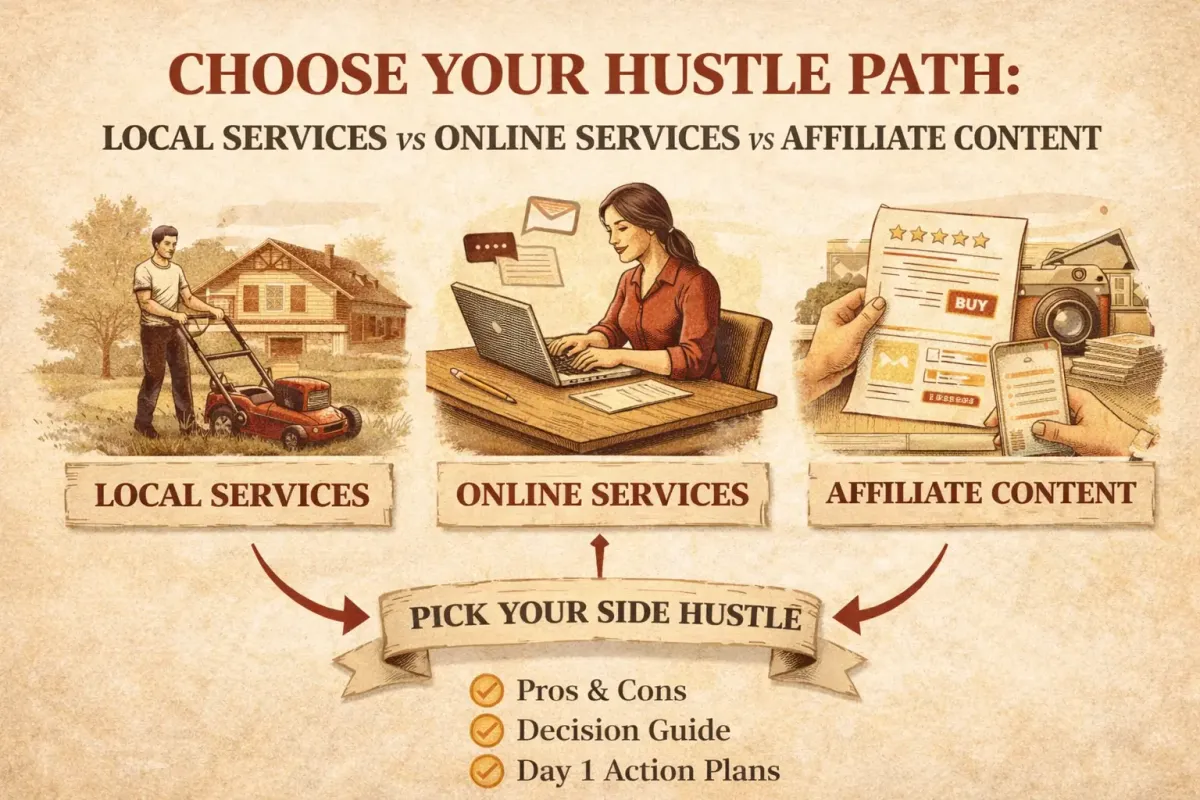
Choose Your Hustle Path: Local Services vs Online Services vs Affiliate Content
Not all side hustles are created equal. This guide compares local services, online services, and affiliate content—who each path is best for, realistic income timelines, and clear first-week action plans to help you choose the right model and start with confidence.
Picking a side hustle is rarely the hard part. The internet is overflowing with ideas.
The hard part is choosing a side hustle model that fits real life: schedule, energy, skills, personality, budget, and how fast money needs to show up. Many beginners don’t fail because they’re lazy—they fail because they pick a model that fights their lifestyle. They start something that requires five hours a day when they only have one. Or they choose a path that needs months of consistency when they need cash this week.
This guide simplifies the decision into three clear hustle paths:
- Local Services (offline side hustle) — fast cash, simple offers, local customers
- Online Services (remote side hustle) — flexible, higher rates possible, remote delivery
- Affiliate Content (media + long-term asset) — slower start, scalable, compounding results
It also includes a decision matrix, honest pros/cons, and a first-week action plan for each path so beginners can stop researching and start earning.
Key rule: Pick one path for the next 30 days. Don’t mix models early. Consistency beats complexity.
The Problem Isn’t Effort—It’s Picking the Wrong Model
Most beginners bring motivation. They buy a domain, join groups, watch videos, and download tools. Then they stall.
Why? Because without a clear model, the side hustle becomes a pile of disconnected tasks. There’s no obvious “next step,” and progress becomes hard to measure.
The big trade-off: Fast money vs long game
Most side hustles sit somewhere on this spectrum:
- Fast money: requires direct effort, usually trading time for income
- Long game: slower at first, but builds an asset that can scale
Local services are usually faster. Affiliate content is usually slower. Online services can sit in the middle depending on skill level and how quickly the side hustler can find clients.
The “do one thing” rule
The simplest way to avoid overwhelm:
- Choose one path
- Commit for 30 days
- Do the basics daily
- Evaluate after 30 days with real data
That’s how beginners stop spinning and start moving.
The 3 Hustle Paths (Quick Definitions)
Path 1: Local Services (offline side hustle)
Local services are in-person work sold to local customers. This path often wins for beginners because it’s straightforward: offer a service, find customers nearby, deliver the work, get paid.
Examples
- cleaning
- lawn mowing / garden tidy
- pressure washing
- pet sitting / dog walking
- moving help
- tutoring
- basic handyman tasks (within comfort and local rules)
Why it works: people already pay for these services, and demand is visible in local communities.
Path 2: Online Services (remote side hustle)
Online services are delivered remotely. The side hustler uses a computer and sells a skill or outcome to clients anywhere.
Examples
- virtual assistant tasks (email, scheduling, admin)
- editing and proofreading
- simple design support (Canva, thumbnails)
- content repurposing (turning long content into short posts)
- customer support
- basic bookkeeping support (non-credentialed caution)
- simple website updates (if skilled)
Why it works: no travel time, repeat clients are possible, and rates can climb as proof builds.
Path 3: Affiliate Content (media / long-term asset)
Affiliate content is publishing content that earns money through affiliate links, ads, sponsorships, and an email list. It’s slower at first, but it can become scalable.
Examples
- niche blog
- newsletter
- YouTube channel
- short-form social with product links
- “best of” lists, how-to guides, comparisons
Why it works: content can keep earning after it’s published (compounding effect), especially with search traffic and email.
Which Path Fits You? The Lifestyle & Personality Filter
These questions choose the model more accurately than hype.
The 7 questions that pick the right model
1) How many hours per week are available?
- 2–5 hours/week: choose a model with low setup friction
- 5–10 hours/week: services or serious content cadence
- 10+ hours/week: any model works, faster progress
2) How fast does money need to show up?
- This week: local services usually win
- This month: online services can work
- 3–6 months: affiliate content becomes realistic
3) Is talking to strangers comfortable?
- If yes: local services and direct outreach become easier
- If no: affiliate content or quiet online services can fit better
4) Is writing or being on camera comfortable?
- If yes: affiliate content becomes a strong option
- If no: services-based models may be better early
5) Is hands-on work enjoyable?
- If yes: local services can feel satisfying and simple
- If no: remote online services may fit better
6) What budget is available?
- $0–$50: local services or online services with existing tools
- $50–$300: basic tools, small ads, simple website
- $300+: more options (equipment, subscriptions, testing)
7) Is the goal quick cash or long-term freedom?
- quick cash: services
- long-term scalable asset: affiliate content
- a blend: online services now, content later
Time-to-First-Income: A Realistic Comparison
Here’s the honest ranking for speed to first dollar:
Local Services: fastest
A motivated beginner can often get paid within days if they:
- offer something simple
- post in local channels
- follow up quickly
Online Services: fast-ish
If the side hustler already has a usable skill and can do outreach, income can happen in 1–3 weeks. If they need skill-building, it takes longer.
Affiliate Content: slowest (but scalable)
Most beginners don’t earn quickly with content. It usually requires:
- consistent publishing
- learning distribution
- building trust
- patience
Affiliate content can pay off—but it’s rarely immediate.
Honest Pros and Cons (So You Don’t Regret It Later)
Local Services: pros and cons
Pros
- fastest path to cash
- low complexity
- simple offers (clear value)
- word-of-mouth and referrals can grow quickly
- can start with minimal tech
Cons
- physical work (sometimes)
- travel time reduces earnings
- schedule can become crowded
- income capped by available hours unless hiring
Best for
- people who want fast income
- people who prefer hands-on work
- people who can handle local outreach
Online Services: pros and cons
Pros
- remote and flexible
- travel time = zero
- higher rates possible over time
- repeat clients and monthly retainers are common
- can niche into higher-value outcomes
Cons
- competition is real
- proof/portfolio helps a lot
- client communication and boundaries matter
- skill clarity is required
Best for
- people who prefer computer work
- people who can write, communicate, and deliver consistently
- people who want flexible location/time
Affiliate Content: pros and cons
Pros
- scalable (income not strictly tied to hours)
- compounding benefits (posts keep working)
- builds an asset (site, channel, list)
- can lead to multiple monetization streams
Cons
- delayed payoff
- consistency required
- needs patience + learning SEO/content/distribution
- easy to quit early due to no results
Best for
- people who can be consistent without immediate reward
- people who like writing, teaching, reviewing
- people who want long-term leverage
Decision Matrix: Pick Your Path in 10 Minutes
Use this simple scoring method. Rate each model from 1 (bad fit) to 5 (great fit).
Score each model
Criteria:
- Speed to income
- Time flexibility
- Skill fit
- Energy fit
- Startup cost
- Scalability
- Risk tolerance
Decision table (copy/paste)
| Criteria | Local Services | Online Services | Affiliate Content |
|---|---|---|---|
| Speed to income | |||
| Time flexibility | |||
| Skill fit | |||
| Energy fit | |||
| Startup cost | |||
| Scalability | |||
| Risk tolerance | |||
| Total |
Tie-breaker rules (when totals are close)
- If cash is urgent → Local Services
- If remote lifestyle matters most → Online Services
- If building a long-term asset is the main goal → Affiliate Content
The “30-day commitment” rule
Once a path is chosen, commit for 30 days with one clear metric:
- local services: inquiries per week + paid jobs per week
- online services: outreach sent + calls booked + paid clients
- affiliate content: posts published + email subscribers + traffic trend
No switching mid-month.
Path 1 — Local Services (Offline Side Hustle)
Local services win because the path to cash is clear: solve a local problem that people already pay for.
Best local service hustles for beginners (short list)
These tend to work well because demand is consistent and the offer is simple:
- basic cleaning (homes, end-of-lease support, “reset clean”)
- lawn mowing / garden tidy
- pressure washing
- dog walking / pet sitting
- tutoring (subjects you know well)
- moving help / heavy lifting
- car detailing basics
- trash haul-away / decluttering help
A beginner should choose something that:
- they can do safely
- they can explain in one sentence
- has obvious demand in local groups
Local services: First-week action plan (day-by-day)
Day 1: Choose offer + area + pricing floor
- pick one service (not five)
- pick service area (your suburb + nearby)
- decide:
- minimum booking
- starting price or packages
Example offer sentence
“Weekend lawn mowing and garden tidy in [area]. Simple pricing, fast bookings.”
Day 2: Basic tools + basic proof
- list the tools needed
- create “proof” even if no clients yet:
- before/after photos of your own yard/room
- a short “about” blurb
- a clean profile image
Day 3: Post where customers already are
Pick 2–3 channels:
- local Facebook groups
- local community boards
- marketplace listings
- local classifieds
Post a clear offer:
- what you do
- where you do it
- starting price / minimum
- how to book (message + details)
Day 4: Outreach + follow-up tracker
Most beginners under-earn because they don’t follow up.
- create a simple tracker:
- name, date contacted, status, follow-up date
- follow-up rule:
- 24–48 hours after initial inquiry if no reply
Day 5: First jobs + review request
The first goal isn’t perfection. It’s proof + momentum.
After a job:
- request a short review
- take before/after photos (if appropriate)
- add to proof folder
Day 6: Refine packages + minimum job size
After a few inquiries:
- notice patterns
- create packages that match what people ask for most
- add a minimum to protect time
Day 7: Repeat outreach
Local services grow through repetition.
- post again
- message previous leads
- ask satisfied customers for referrals
Local services scripts (copy/paste)
Inquiry response
“Thanks for reaching out—happy to help. What suburb are you in and what do you need done? Once that’s clear, I’ll confirm the price and next available time.”
Quote
“For that scope, the price is $X and includes [scope]. Next times available are [times]. If you’d like to lock it in, confirm a time and payment method.”
Review request
“Thanks again—really appreciate it. Would you be open to a quick 1–2 sentence review? It helps a new local service a lot.”
Path 2 — Online Services (Remote Side Hustle)
Online services are for people who want flexibility and can deliver outcomes from a laptop.
Best online service hustles for beginners
Beginner-friendly options:
- virtual assistant tasks (scheduling, admin, inbox organization)
- editing/proofreading
- Canva design support (simple graphics, thumbnails)
- content repurposing (turn long content into short posts)
- customer support and chat support
- simple research and data entry
- basic bookkeeping support (only within comfort and local rules)
A beginner should pick one skill and one outcome.
Examples:
- “Convert long articles into 10 short posts”
- “Clean up and format resumes”
- “Inbox cleanup + scheduling system setup”
Online services: First-week action plan (day-by-day)
Day 1: Pick one skill + one niche (optional)
Niche helps, but it’s not required on day one.
Examples of “light niches”:
- real estate agents
- local trades
- small ecommerce stores
- coaches/creators
- busy professionals
Day 2: Create one portfolio sample
Even without clients, create a sample:
- a mock before/after
- a demo graphic set
- a sample edit with tracked changes
- a “mini case study” explaining process
Day 3: Set packages + boundaries
Create 2–3 packages:
- Basic
- Standard
- Premium
Include:
- turnaround time
- number of revisions
- what’s included (scope)
Day 4: Build a lead list + send outreach
Goal: 50 leads + 10 messages/day.
Lead sources:
- social profiles
- directories
- job boards (for leads, not employment)
- communities
Outreach should be short, specific, and helpful.
Day 5: Proposals + follow-ups
Follow-up is where clients appear.
Rule:
- follow up 48 hours later
- keep it friendly and low pressure
Day 6: Close first client + simple onboarding
Onboarding checklist:
- confirm scope in writing
- confirm payment method
- request access/info
- confirm deadline
Day 7: Deliver + testimonial request
After delivery:
- request testimonial
- ask what else they need
- offer a small retainer option if appropriate
Online outreach scripts (copy/paste)
Cold message
“Quick one—noticed you’re posting consistently, but [pain point]. I help with [specific outcome]. If you want, I can do a small sample for free so you can see the quality.”
Follow-up
“Just checking in—happy to send a quick sample if helpful. If timing isn’t right, no worries.”
Path 3 — Affiliate Content (Affiliate Side Hustle)
Affiliate content is not “easy money.” It’s publishing plus trust.
The reason it works long-term is that content can compound. A useful article can bring traffic for months. A good email list can create repeat clicks and sales. But it requires patience.
What affiliate content is (and isn’t)
It is:
- creating helpful content for a specific audience
- recommending relevant tools/products/services
- building trust and consistency
- learning distribution (search + social + email)
It isn’t:
- posting random links and expecting commissions
- copying other people’s content
- expecting instant results
Affiliate content: First-week action plan (day-by-day)
Day 1: Pick niche + audience + angle
Niche doesn’t have to be tiny, but it must be clear.
Good niches have:
- buyers
- problems
- products/tools people already search for
Day 2: Build a topic list (10 ideas)
Create:
- 1 pillar article (big guide)
- 9 supporting articles
Examples:
- best tools for X
- X vs Y comparisons
- beginner guides
- checklists
- mistakes to avoid
Day 3: Set up basics
Minimum viable setup:
- a place to publish (site or newsletter)
- simple branding (name + logo optional)
- a subscribe form (email list matters)
Day 4: Write the first post (best effort)
Don’t aim for perfect. Aim for published.
Day 5: Publish + basic on-page structure
Include:
- clear headings
- internal links (link to related posts as you publish)
- a simple call to subscribe
Day 6: Repurpose to social + build email list
Turn the post into:
- 1–3 short social posts
- an email newsletter issue (even if list is tiny)
Day 7: Write the second post
Momentum matters. Affiliate content is a volume and consistency game.
Affiliate content timeline (realistic milestones)
0–30 days
- publish consistently
- learn what people click
- start collecting emails
30–90 days
- early traffic begins (varies)
- build internal links
- refine topics
90–180 days
- possible first commissions (varies)
- content library grows
- compounding effect starts
If a beginner needs money immediately, affiliate content should not be the only plan.
Common Mistakes When Choosing a Model
Mixing all three at once
This creates overwhelm and zero progress.
Picking a model that fights personality
If someone hates talking to strangers, local services may feel painful.
If someone hates writing, affiliate content may feel impossible.
Overbuilding before selling
Tools and branding don’t create income. Selling does.
Avoiding outreach and follow-up
Especially for service models, outreach is the job early on.
Expecting affiliate content to pay immediately
Content is a long game. It requires patience.
How to Combine Paths Later (Without Chaos)
Combining models can work after a stable base exists.
A sequence that works for many beginners:
- Services for cash flow
- Content for long-term leverage
For example:
- local services earn immediate income
- content documents lessons and recommends tools used
- eventually, content creates passive-ish traffic
But early on: one path, one focus.
FAQs: Choosing a Side Hustle Model
What side hustle makes money the fastest?
Local services often produce the fastest first income because customers already exist and the offer is simple.
What is the best side hustle for beginners with no experience?
Beginner-friendly options include simple local services, reselling, or entry-level online services like admin support—depending on comfort and schedule.
Is affiliate marketing still worth it in 2026?
Affiliate content can work when it’s built on trust, useful content, and consistent publishing. It’s slower, but scalable.
Should you start an online side hustle or local service?
Local services suit people who want fast cash and don’t mind in-person work. Online services suit people who want remote flexibility and can sell a clear outcome.
How long does it take to make money from content?
It varies, but most beginners should expect months, not days. Consistency matters more than hype.
Conclusion: Choose One Path for 30 Days
The best hustle path is the one a person can actually stick to.
- If money is needed fast: Local Services
- If flexibility and higher rates matter: Online Services
- If long-term scalable income is the goal: Affiliate Content
Pick one for 30 days. Follow the first-week plan. Track simple metrics. Then decide what to double down on based on real results—not guesses.
Subscribe to Hustler Herald for weekly playbooks, templates, and simple systems that help beginners start earning.