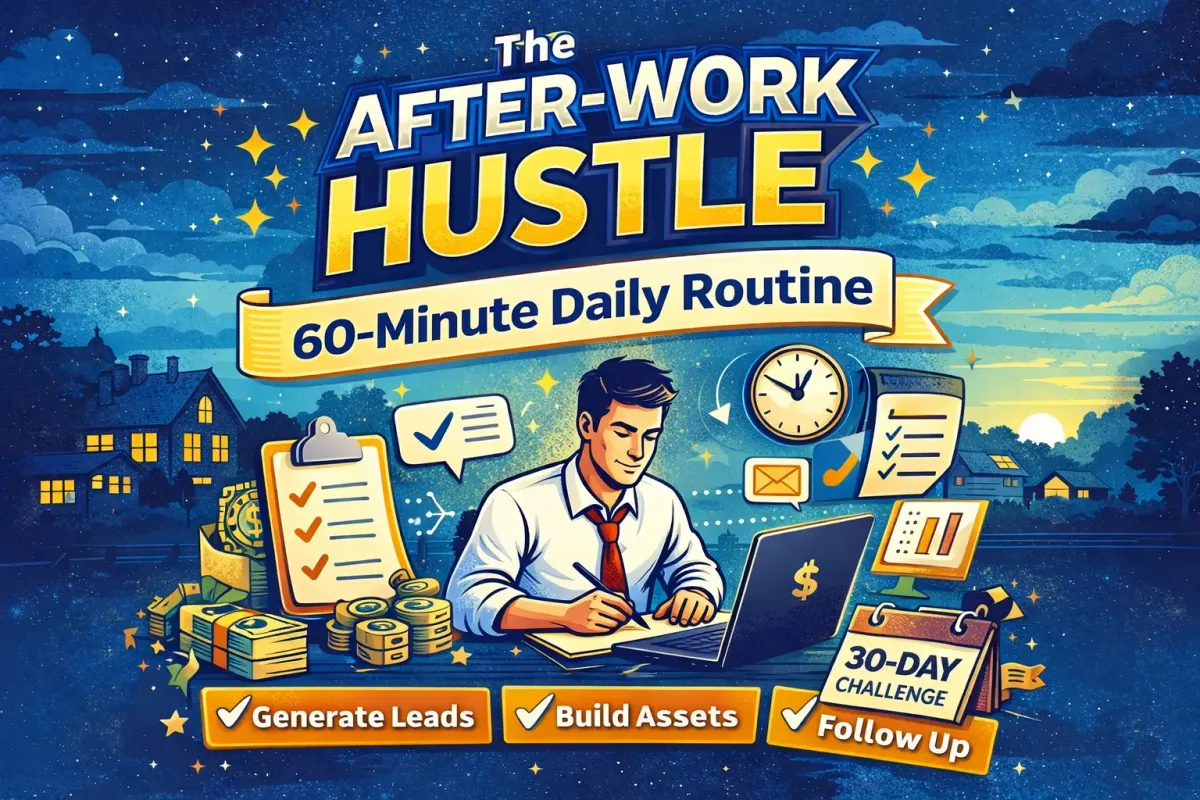
The After-Work Hustle: A 60-Minute Daily Routine to Build Income
A simple 60-minute after-work routine to build a side hustle without burnout—what to do each day, how to stay consistent when tired, and a 30-day challenge to turn small daily reps into real side income.
Building a side hustle rarely fails because the idea is bad. It fails because life gets busy.
After a full day of work, the brain is tired, motivation dips, and it’s easy to tell a familiar story: “I’ll start properly on the weekend.” Then the weekend gets filled up, and the side hustle stays stuck in the planning phase.
That’s why a side hustle daily routine matters more than talent, tools, or even the “best” idea. A routine removes decision fatigue. It creates momentum. And it turns small daily actions into compounding progress.
This guide lays out a realistic, repeatable 60-minute after-work routine that fits around a 9–5 schedule. It also includes a weekly rhythm, plug-and-play task menus, and a 30-day challenge—so anyone can build income without burning out.
The Principle: Consistency Beats Intensity
When beginners imagine side hustle success, they often picture big bursts of effort:
- a full weekend building a website
- a late-night productivity sprint
- an ambitious plan that lasts three days
Intensity feels productive, but it’s unreliable. Consistency is what builds income.
Why routines create side hustle income
A routine does three things that beginners typically struggle with:
- It reduces decision fatigue.
When the routine is the same each day, the brain doesn’t waste energy deciding what to do. The work starts faster. - It creates a habit loop.
Show up, do the work, get a small win. The win creates motivation to return. - It compounds progress.
A single 60-minute session won’t transform a side hustle. But 20 sessions in a month will.
This is why a daily routine is often the best routine for building a side hustle—even if it’s not perfect.
The 3 daily “income drivers”
Most side hustles, online or offline, grow through the same three drivers:
- Lead generation
Finding people who might pay. This includes outreach, posting, listings, partnerships, and follow-ups. - Offer improvement
Making the offer easier to buy. This includes better pricing, clearer packages, proof, and stronger messaging. - Delivery
Doing paid work well. This includes fulfilling orders, completing jobs, and improving quality so customers come back and refer others.
A good routine touches all three—but prioritizes lead generation early, because no leads means no income.
Set Up the 60-Minute Routine (Before Day 1)
The routine works best when it’s built on a few simple decisions made once. Without setup, the 60 minutes will be wasted on “figuring out what to do.”
Pick one hustle lane for 30 days
The biggest reason beginners fail is switching ideas too often.
A simple rule helps:
Pick one side hustle lane for 30 days. No switching.
This doesn’t mean a person is locked in forever. It means they stay focused long enough to see traction.
How to choose a lane (fast)
Choose the option that matches:
- time availability (after-work only vs weekends too)
- budget (low-cost start vs needs equipment)
- energy (mental work vs physical work)
- skills (existing strengths vs new learning)
- lead source (where customers will come from)
Examples of beginner-friendly lanes
- Local services: cleaning, lawn care, detailing, dog walking
- Freelancing/services online: VA, editing, basic design support, tutoring
- Reselling: marketplace flipping, decluttering sales, small flips
- Content/affiliate (slower): blogging/newsletter with consistent publishing
A beginner doesn’t need the perfect lane. They need one lane they can commit to.
Define the “one outcome” offer
Once the lane is chosen, the offer needs to be simple enough to explain in one sentence.
A useful template:
“I help [who] get [result] without [pain].”
Examples:
- “I help busy families get a clean home without spending weekends cleaning.”
- “I help local businesses stay visible online without posting every day.”
- “I help students improve math grades without last-minute cramming.”
- “I help people turn clutter into cash without wasting hours selling.”
A clear outcome offer makes it easier to:
- reach out to people
- create posts and listings
- price confidently
- deliver consistently
Create a simple scoreboard (so progress is visible)
Most beginners quit because they feel like “nothing is happening.” A scoreboard makes progress visible.
A side hustle scoreboard should track:
Daily
- Outreach attempts (messages sent, posts made, listings updated)
- Follow-ups sent
- One “asset” built (proof, template, sample, improvement)
Weekly
- Leads generated (replies, inquiries)
- Bookings/sales
- Revenue
- Hours spent
- Notes on what worked
This can live in:
- a notes app
- a simple spreadsheet
- a paper checklist
Tracking matters because it shows the truth: progress is often happening before money shows up.
The 60-Minute After-Work Routine (Daily Template)
This is the core routine. It’s designed to be:
- simple
- repeatable
- effective for both online and offline hustles
The goal is to spend the hour on side hustle things to do that directly lead to income.
Minute-by-minute structure
0–5 minutes: Reset + choose one goal
This prevents the classic after-work spiral of:
- checking messages
- scrolling
- tinkering with branding
- never starting
A simple reset:
- drink water
- stand up
- open the checklist
- choose one goal
One goal examples:
- “Send 10 messages.”
- “Create one listing.”
- “Follow up with leads.”
- “Finish one paid task.”
- “Post one offer.”
5–25 minutes: Lead generation (the money engine)
This is the most important block. It’s the part that creates customers.
Lead generation activities include:
- sending DMs
- emailing businesses
- updating a marketplace listing
- posting in local groups (where allowed)
- applying to gigs
- contacting potential partners
- responding to inquiries quickly
A beginner should treat lead generation like brushing teeth. Not exciting—but necessary and powerful.
25–45 minutes: Build assets (make selling easier tomorrow)
This block improves the offer so future outreach converts better.
Asset-building activities include:
- writing a better “one sentence offer”
- creating a small portfolio sample
- improving a pricing package
- writing scripts for outreach
- collecting testimonials
- taking before/after photos
- creating a checklist for delivery
- improving a listing description
A side hustle gets easier when it has assets. Assets reduce friction and increase trust.
45–55 minutes: Follow-up + admin (close the loop)
Follow-up is where many side hustles make money. Most beginners under-use it.
This block is for:
- replying to messages
- confirming bookings
- sending simple quotes
- invoicing
- scheduling
- organizing supplies
- prepping for tomorrow
The goal is to keep the pipeline moving.
55–60 minutes: Plan tomorrow (one clear next action)
The routine ends with a short plan so the next session starts fast.
Pick one task for tomorrow:
- “Send 10 DMs to local families.”
- “List 5 items.”
- “Email 5 businesses with a simple offer.”
- “Create a second package option.”
This reduces decision fatigue and increases consistency.
What “Lead Generation” Looks Like (By Hustle Type)
Different hustles generate leads differently, but the routine stays the same. Only the actions change.
Local services (cleaning, lawn, detailing, pet care)
Lead gen examples:
- post offer in 1 local group (if allowed)
- DM 10 warm contacts for referrals
- message 5 local businesses about partnerships
- drop 1–2 flyers (optional) on the way home
- respond quickly to inquiries
The main advantage of local services is speed to first income. The challenge is consistency and scheduling.
Freelancing and online services (VA, editing, tutoring)
Lead gen examples:
- send 10 targeted outreach messages
- apply to 3–5 gigs with a simple proposal
- follow up with old leads
- update portfolio sample or profile
The advantage is flexibility and scalability. The challenge is standing out and staying consistent with outreach.
Reselling/flipping
Lead gen examples:
- list 3–5 items
- update pricing on stale listings
- message buyers quickly
- source items (small daily sourcing or weekend block)
The advantage is fast cash flow. The challenge is discipline with listing and sourcing routines.
Content/affiliate/newsletter (slower build)
Lead gen examples:
- publish one small piece of content or update
- distribute it (share it in 2 places)
- email list building actions (simple lead magnet or sign-up push)
The advantage is building an asset. The challenge is delayed income.
The Daily Non-Negotiables (What to Do Every Day)
A daily routine needs a few “non-negotiables” that create income.
Non-negotiable #1: Outreach or listing
- outreach = messages, emails, posts
- listing = items, gigs, services
Non-negotiable #2: Follow-up
- follow up on every lead within 24 hours when possible
- follow-up doubles conversion for many beginners
Non-negotiable #3: Build one asset
- small improvement each day
- the offer becomes easier to buy over time
If a person does these consistently, income tends to show up.
The Weekly Rhythm (So 60 Minutes Produces Income)
Daily actions create momentum, but weekly structure improves outcomes.
Here’s a simple Monday–Friday rhythm that fits a 9–5 life.
Monday: Set the offer + outreach
- choose weekly offer focus (one package or one goal)
- send outreach messages
- update listings
Tuesday: Outreach + proof building
- outreach block
- build proof: testimonial request, before/after, sample work
Wednesday: Follow-up sprint (the “closing” day)
- follow up on all open leads
- send simple “checking in” messages
- aim to book the next job or sale
Thursday: Delivery and system day
- complete paid work
- improve delivery checklist
- fix bottlenecks (pricing, scripts, scheduling)
Friday: Review + tighten standards
- review the scoreboard
- decide what worked
- improve the offer slightly
- plan the next week
Weekend power block (optional 2–3 hours)
Not everyone has weekends free, but if they do, a weekend block can accelerate progress.
Use it for deep work:
- batch outreach and content
- bulk listing (reselling)
- multiple service jobs in one day
- building a portfolio or sample set
The goal is not to work nonstop. It’s to do one focused block that reduces stress during the week.
Plug-and-Play Menus: What to Do Each Day
A routine fails when someone sits down and doesn’t know what to do. Menus fix that.
Daily lead gen menu (pick 1–2)
- Send 10 DMs to warm contacts asking for referrals
- Send 5 cold emails/DMs to targeted businesses
- Post 1 offer in a relevant community (where allowed)
- Update 1 listing with better title/photos/pricing
- Apply to 3 gigs with a short, specific pitch
- Contact 1 partnership lead (agent, local business, supplier)
- Follow up with 5 leads from previous days
Daily asset menu (pick 1)
- Improve the one-sentence offer
- Create one package option (basic vs premium)
- Write 3 outreach scripts (DM, follow-up, booking)
- Create a simple “proof” post (testimonial, before/after)
- Build a checklist for delivery
- Create a portfolio sample (one page, one example)
- Improve pricing boundaries (minimum job size, service area, hours)
Daily delivery/admin menu (pick 1)
- Respond to all inquiries
- Confirm bookings and times
- Invoice and collect payment
- Prep supplies / tools
- Update tracking sheet
- Organize files/templates
- Plan tomorrow’s one task
This keeps the routine flexible while still structured.
How to Stay Consistent (Even When Tired)
After work, energy is limited. A routine has to work on low-energy days.
The “minimum viable session” (15-minute fallback routine)
If a person can’t do the full hour, they should do 15 minutes instead.
A simple 15-minute fallback:
- 10 minutes: outreach or follow-up (send 5 messages)
- 5 minutes: plan tomorrow
This prevents the “all or nothing” cycle.
The “never miss twice” rule
Missing one day is normal. Missing two days creates a pattern.
The rule:
- If a day is missed, the next day is non-negotiable—even if it’s only the 15-minute session.
Remove decision fatigue
Decision fatigue kills consistency. Reduce it with:
- same time each day (even approximate)
- same location (desk, couch, kitchen table)
- same first step (open checklist, send outreach)
When the first step is automatic, the routine becomes easier.
Motivation that actually works
Motivation is unreliable. Progress systems are reliable.
Practical motivation tools:
- track streaks (even if it’s 15 minutes)
- use a visible checklist
- celebrate process wins (messages sent, not just money earned)
- set a simple weekly target (e.g., 50 outreach messages)
A beginner should focus on controllable actions, not outcomes.
Avoid Burnout (Sustainable Hustle Rules)
A 60-minute routine should build income, not destroy health.
Set boundaries early
Boundaries prevent side hustles from turning into stress.
Examples:
- “No work after 9 PM”
- “No jobs more than 20 minutes away”
- “Minimum job size is $X”
- “Two clients per week max to start”
- “No last-minute bookings without a premium fee”
Boundaries are not selfish. They keep the hustle sustainable.
Protect energy and sleep
If after-work hustle time destroys sleep, the side hustle collapses eventually.
A better approach:
- use the 60 minutes earlier in the evening
- avoid caffeine late
- keep the session structured and stop on time
If evenings are too hard, consider:
- 30 minutes in the morning
- or 2–3 longer weekend blocks
The best routine is the one that can be repeated for months.
When to take a deload week
Burnout signs:
- constant dread
- sleep problems
- irritability
- procrastination
- “checking out” during sessions
A deload week doesn’t mean stopping. It means switching to lighter tasks:
- follow-ups only
- organizing and planning
- small improvements
- rest
Momentum can stay alive without grinding.
Common Mistakes With a Side Hustle Daily Routine
Mistake #1: Spending all 60 minutes learning instead of building
Learning has a place, but beginners often hide in learning to avoid outreach.
A better ratio:
- 80% action (outreach, building, delivery)
- 20% learning (only if needed to unblock action)
Mistake #2: No outreach, no follow-up
A side hustle without outreach is a hobby.
Even reselling requires:
- listing
- responding quickly
- pricing adjustments
Mistake #3: Rebuilding logos, websites, and branding too early
Branding is fun. It also delays income.
A beginner should prioritize:
- offers
- proof
- leads
- delivery
The rest can come later.
Mistake #4: Trying to run three hustles at once
Three hustles means:
- shallow progress
- constant switching
- no consistency
One lane for 30 days beats three lanes for three days.
Mistake #5: No weekly review
Without review, the same mistakes repeat.
A weekly review is how the routine gets smarter over time.
The 30-Day After-Work Hustle Challenge (Printable Plan)
This challenge turns the routine into a simple 30-day progression.
Week 1: Choose lane + first outreach + first proof
Goals:
- pick one hustle lane
- write the one-sentence offer
- send outreach daily
- create one proof asset (sample, before/after, testimonial)
Daily focus:
- 10 outreach messages/day
- 1 asset built across the week
Week 2: Build a lead pipeline + tighten the offer
Goals:
- increase outreach consistency
- improve scripts
- improve packaging
- respond faster
Daily focus:
- outreach + follow-up
- create a second offer option (basic vs premium)
Week 3: First paid work + process improvements
Goals:
- complete paid work professionally
- collect testimonials
- build delivery checklists
- reduce time waste
Daily focus:
- deliver well
- ask for reviews
- refine pricing and boundaries
Week 4: Stabilize + raise standards
Goals:
- make the routine sustainable
- set weekly targets
- increase conversion through proof
- slightly raise prices or minimums if demand supports it
Daily focus:
- improve systems
- schedule ahead
- turn customers into referrals
Troubleshooting: What If Nothing Happens By Day 10?
This is a common fear. Often the issue isn’t the hustle—it’s one of these:
1) Not enough outreach volume
If only 3 messages were sent per day, the sample size is too small. Increase outreach.
A realistic benchmark:
- 10–20 outreach attempts per day for 10 days creates meaningful data.
2) The offer is unclear
If people don’t understand what’s being offered, they won’t respond.
Fix:
- rewrite the one-sentence offer
- add a clear package
- add a price range
3) The channel has no buyers
Posting in places without buyers wastes time.
Fix:
- move to channels where buyers already search (marketplaces, local groups, direct outreach)
4) No follow-up
Many leads need a second message. Beginners often stop after one attempt.
Fix:
- follow up 24–48 hours later with a simple check-in.
FAQs: Side Hustle Daily Routine and After-Work Hustling
What should someone do every day to build a side hustle?
They should do at least one lead-generation action daily (outreach, listing, posting), follow up on leads, and improve one asset that makes the offer easier to buy.
Can a side hustle be built with only 1 hour a day?
Yes, many side hustles can be built with consistent daily time—especially service-based and reselling models. Consistency matters more than occasional long sessions.
What is the best daily routine for building a side hustle?
A strong routine includes: lead generation, offer improvement, follow-up/admin, and planning the next day. The routine should be repeatable on low-energy days.
How do you start a side hustle after work when you’re tired?
Use a structured routine, reduce decision fatigue, and build a 15-minute fallback plan. The goal is to show up consistently, not to rely on motivation.
How long does it take to make money from a side hustle?
It depends on the hustle and time invested. Local services and reselling often earn faster; content-based hustles take longer. Consistent outreach tends to speed up the timeline.
What should you focus on first: learning or selling?
Beginners should focus on selling and validation first. Learning should support action, not replace it.
How do you avoid burnout with a side hustle?
Set boundaries, protect sleep, limit scope early, and use a routine that can be repeated for months. Take lighter weeks when needed instead of quitting completely.
Conclusion: Start Tonight With One Hour
A side hustle doesn’t require massive free time. It requires a repeatable routine that fits real life.
This 60-minute after-work routine works because it focuses on the actions that actually create income:
- lead generation
- offer improvement
- follow-up and delivery
The next step is simple: start tonight.
Do one 60-minute session. Keep it small. Keep it consistent. And let momentum do what motivation can’t.
Subscribe to Hustler Herald for weekly routines, playbooks, and step-by-step guides built for 9–5 schedules.